
Do You Actually Need to Buy a New Attendance Device?
Some vendors say third-party attendance hardware cannot be trusted. They are right about one kind of integration and wrong about the rest.

There is probably a biometric device on the wall near your back entrance. It was bought a few years ago, it works, and it captures every punch correctly.
And yet at the end of every month somebody downloads a file from it, opens it in Excel, fixes the employee IDs that do not match, hunts for missing punches, and types the result into payroll.
Several software vendors have looked at that situation and concluded the answer is to sell you a new device. The most prominent in India is Attendo — formerly Petpooja Payroll, rebranded in 2026 — which ships its own attendance hardware in every package.
Their reasoning is worth taking seriously, because it is half right. This post is about which half.
1. The claim, stated fairly
Attendo's marketing is direct. It tells owners to say goodbye to loosely integrated payroll hardware and software systems. Its device page promises no sync-in or integration issues, ever. Its About page adds that Petpooja supports the device directly, with no third party and no runaround.
Unpacked, the argument runs: connecting third-party attendance hardware to payroll software is unreliable, so we build both ends and the problem disappears.
The first half of that is true. Anyone who has run attendance through a device vendor's desktop software and hand-carried numbers into payroll knows exactly how brittle it is.
The second half does not follow. Owning both ends is one way to fix it. It is not the only way, and it is not free.
2. There are four ways a punch reaches payroll, not two
This is the distinction the claim depends on, and almost no buyer knows it exists.
A device captures a fingerprint, face or card event and forms a punch record. What happens next falls into one of four patterns:
ADMS or WDMS push. Common on eSSL and ZKTeco hardware. The device itself posts each punch outward to a URL you configure, every few seconds. No desktop software, no local database, no PC that must stay switched on.
REST webhook. Found on Matrix COSEC and Realtime devices. A JSON payload hits the software's endpoint the moment the punch is captured.
Device SDK with a local agent. Used for brands like Anviz and Secureye. A service running on a machine at your premises pulls punches using the vendor's SDK and forwards them. It works, but there is now a PC in the path.
Scheduled read from the device vendor's database. The oldest pattern and still widespread. A client application reads new records out of the device software's own database — MS SQL, MySQL or MS Access — and forwards them at intervals. Several large HRMS platforms in India still connect this way.
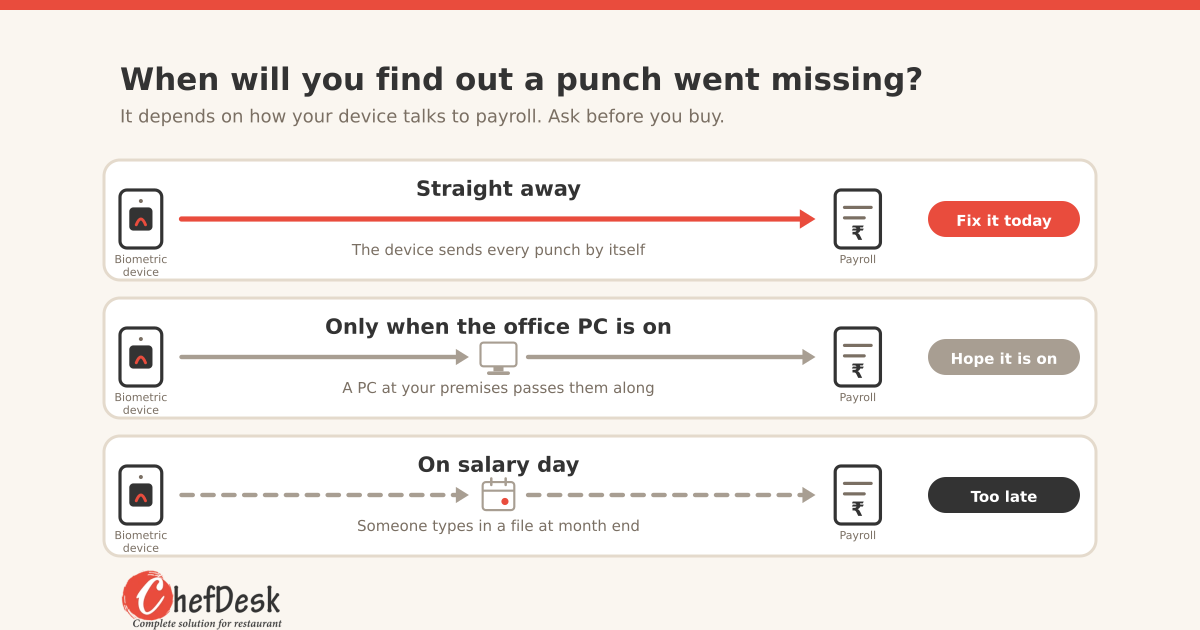
The first two are real-time. The third is near real-time with a dependency you own. The fourth is batch wearing real-time's clothes.
3. What Attendo's argument actually defeats
Read the claim again with those four in mind.
"Loosely integrated hardware and software" is an accurate description of the fourth pattern, and a fair criticism of the third. Those integrations do fail, and they fail in ways owners recognise:
You find out too late. A punch missing on the 4th surfaces on the 1st, when nobody can reconstruct what happened three weeks ago.
A manual step exists, so eventually it goes wrong. Wrong date range, wrong branch, duplicate rows, a device clock that drifted eleven minutes.
Nobody owns the failure. The payroll vendor says the file was bad. The device vendor says the device recorded correctly. Both are telling the truth, and your salary run is due.
So the criticism lands — against batch integration.
It says nothing at all about ADMS push, where the device sends every punch directly to the payroll platform as it happens, with the device vendor's software nowhere in the path. That capability has existed on commodity Indian hardware for years. It is not a workaround or a bridge. It is a feature the device shipped with.
The claim, then, is a real problem attached to an unnecessary conclusion. Batch integration is unreliable. The fix is real-time integration, not new hardware.
4. What real-time push means in practice
When the device pushes directly to a payroll platform:
No software runs at your premises. No desktop client, no scheduled export, no PC in the back office that a cleaner can switch off.
An ordinary broadband connection is enough. Because the device dials outward, you need no static IP and no port forwarding. If a vendor asks for either, you are looking at a different architecture — worth knowing before you sign.
The register is live. You see who punched in at 11:04 while it is still 11:04. Late marks, absences and overtime accumulate as the month runs rather than being reconstructed after it ends.
That last point is the whole benefit Attendo is selling. It is achievable without buying their device.
5. What the bundled device costs you
None of this makes Attendo a bad product. Bundling genuinely does eliminate a class of problem, and for a business with no device installed and no appetite for technical questions, it is a reasonable purchase.
Two costs are worth weighing.
You buy hardware you may already own. If a working device is on the wall, a bundled purchase replaces it and you re-enrol every fingerprint. Across five sites, that is five devices and several hundred enrolments to redo on hardware that replaced hardware that was working.
Serviceability changes shape. This is the one most buyers underestimate.
Single-vendor support is administratively simpler — one number to call. But the question that matters when a device dies mid-week is not who answers the phone. It is how quickly you are running again.
Commodity brands like eSSL and ZKTeco have been sold in India for well over a decade, with dealers in essentially every city and any local security-systems technician able to service them. Three things follow:
- You can keep a spare. A basic fingerprint unit sits around ₹6,000–7,000 and a mid-range face device around ₹14,000, by third-party estimates. At those prices a multi-site business can hold a replacement in the office and swap it in inside fifteen minutes. No support contract beats that, and you cannot do it economically with a device that has one supplier.
- Anyone can fix it. Local IT and security technicians work with these devices daily. A proprietary unit has one qualified set of hands.
- It will not be orphaned. If a software company discontinues its device line, or the product, or is acquired, that hardware is stranded. The eSSL and ZKTeco ecosystem is far larger than any single software vendor.
6. Questions that settle it
Ask these of any vendor, including us. The answers are more useful than feature lists.
- Does the device push to you, or do you read from the device vendor's database on a schedule? This single question sorts the market.
- Does anything have to run at my premises — a PC, a local service, a Tomcat server?
- Do I need a static IP or a port opened?
- What happens to punches when the internet drops, and what happens when it comes back?
- Which exact device models have you run in production, as opposed to which brands you support?
- How are mismatched employee IDs handled? The device knows employee 47; payroll knows EMP-2024-0112.
- If I stop subscribing, what happens to the device?
- Can I export my attendance and payroll history myself, without raising a ticket?
7. Two things worth getting right on the hardware side
Match the sensor to the environment. Fingerprint readers struggle with wet, oily and greasy hands, which rules them out for many kitchens and workshops. Attendo markets a device that handles this, and that is a legitimate advantage over a cheap generic reader. But the fix is choosing the right device class — a face recognition or multi-biometric unit — not choosing a different payroll vendor. Any software that reads commodity devices can read a face device too.
Biometric data is sensitive, and it is your responsibility. A fingerprint template is personal data, and under India's DPDP framework your business is the entity accountable for it, not your software vendor. Ask any provider: are templates encrypted at rest, is there a consent record for each enrolment, where is the data hosted, and what happens to an employee's biometric record when they leave. Most vendors have never been asked. The ones with a clear answer have thought about it.
8. The alternatives
Disclosure: Zaravya HRSuite is our own product. It is listed because it belongs in this category, and marked so you can weigh it accordingly. Everything below reflects what each vendor publishes about itself — we have not independently tested any of them, competitors included. Verify directly before deciding.
| Platform | Devices it claims to support | Pattern described |
|---|---|---|
| Attendo | Its own bundled hardware | Device to their cloud, real-time |
| HROne | ZKTeco, eSSL, Matrix, Realtime, Spectra; claims 200+ device families | Real-time push API |
| Zoho People | eSSL, ZKTeco, Biomax, Matrix, CAMS, Hikvision | API and plugin based; commonly implemented via a partner, with server-side setup |
| PeopleStrong Alt | eSSL, ZKTeco, Biomax, Matrix | Web service endpoint fed by a client application reading the device database at intervals |
| Odoo 20 | eSSL, Mantra, ZKTeco BioTime | Native integrations introduced in the Odoo 20 release |
| SaachiHRMS | ZKTeco, eSSL, Realtime, Suprema; claims 100+ devices | Automatic sync into payroll |
| AionHRMS | eSSL, ZKTeco, Realtime | Terminal pushes to cloud; no desktop software or local database |
| Zaravya HRSuite (ours) | eSSL and other common makes | Device pushes directly to our cloud in real time; device vendor's portal not in the path. Attendance, shifts, leaves and payroll with PF, ESIC and PT |
Read the third column more carefully than the second. Almost everyone supports the same brands — that is the easy part, and it is why brand lists are a poor way to choose. What separates these platforms is how the punch actually travels. A platform reading from the device vendor's database on a schedule is offering something meaningfully different from one the device posts to directly, whatever the feature list says.
The short version
Attendo is right that loosely integrated attendance systems fail. It is wrong that buying their hardware is the only fix.
The failure they describe belongs to batch integration — exports, scheduled reads, a PC in the back office. Real-time push solves it, and commodity devices from eSSL and ZKTeco have supported it for years. You can have the live attendance register without replacing anything.
So the question is not whether integration works. It is which kind of integration you are being sold. Ask where the punch goes when it leaves the device, and insist on a specific answer rather than the word "integrated."
If you already own a working device, look for software that reads it directly. If you do not, buy the device that suits your environment — and keep the ability to change software later without changing hardware.
Sources
Attendo's product claims and hardware bundling
- About Attendo — the rebrand from Petpooja Payroll, and direct device support: https://attendohr.com/about-us
- Petpooja's payroll page — the biometric device, and the "no sync-in or integration issues" claim: https://www.petpooja.com/payroll
- Petpooja blog, on the rebrand and current scope: https://blog.petpooja.com/people-payroll/petpooja-payroll-is-now-attendo/
- Attendo feature overview — roster planning, the 40,000-business figure: https://attendohr.com/blog/payroll-software-features
- Attendo Admin app listing — "comes with its own hardware", and the messaging about loosely integrated systems: https://play.google.com/store/apps/details?id=com.petpooja.attendance
- Capterra India listing — attendance hardware included in every package: https://www.capterra.in/software/1078498/Petpooja-Payroll
How devices connect to HR platforms
- HRMS integrations in India, describing the four ingestion patterns — ADMS/WDMS push, REST webhook, device SDK, and cloud API with offline sync: https://hrone.cloud/blog/hrms-integrations-india-tally-sap-biometric/
- Attendance software buyer criteria, including device ecosystem and push API: https://hrone.cloud/blog/attendance-management-software-india-2026/
Platform-specific integration detail
- Zoho People biometric integration, API and plugin based, with the server-side setup involved: https://ampletrails.com/biometric-device-integration-with-zoho-people
- Zoho People biometric partners and device coverage: https://codroiditlabs.com/best-zoho-people-biometric-partner-india/
- PeopleStrong Alt — web service endpoint fed by a client application reading the device database: https://ampletrails.com/biometric-attendance-integration-with-peoplestrong-alt-essl-zkteco-biomax-matrix-ampletrails/e-learning-blog
- Odoo 20 biometric integrations for eSSL, Mantra and ZKTeco: https://ahex.co/odoo-20-biometric-integration-attendance-essl-mantra-zkteco/
- AionHRMS — terminals pushing to cloud, no desktop software: https://aionhrms.com/
Device selection and pricing
- Biometric device buyer's guide, February 2026 — brand comparison and the indicative prices cited in Section 5: https://saachihrms.com/blog/biometric-attendance-system-buyers-guide-2026
A note on these sources: several are published by companies selling in this market, including direct competitors and integration service providers. We have cited them where they describe their own products or explain widely documented technical patterns, and we have said which claims are theirs. Treat vendor-published capability claims — ours included — as claims rather than verified fact.
General guidance, not a product endorsement. Vendor capabilities are as published by those vendors as of September 2026 and change frequently. Attendo and Petpooja are trademarks of their respective owners.