
Cafe loyalty programs: the 3 that actually work
Which structure fits which cafe, the numbers behind each, and the reason most programs quietly die in month three.
Which structure fits which cafe, the numbers behind each, and the reason most programs quietly die in month three.
Cafes are the best business in food for loyalty, and most of them run the worst version of it.
The advantage is structural. A cafe sells a low-value item to the same person repeatedly, often at the same time of day. Nobody eats at your restaurant four times a week. Plenty of people drink coffee four times a week, and the only question is whose.
That is the whole opportunity: you are not persuading someone to visit more often. You are persuading someone who already visits somewhere every morning to make it yours.
Here are the three structures that do that, and how to tell which one is yours.
1. The stamp card — the right default for most cafes
Buy eight, get one free. Everyone understands it without being told, which matters more than anything clever you could design.
Why it works: it matches how cafes are actually used. A daily regular finishes a card in about two weeks, so the reward feels close enough to change behaviour. Reported lifts sit around 20% on repeat visits, though see the note on numbers below.
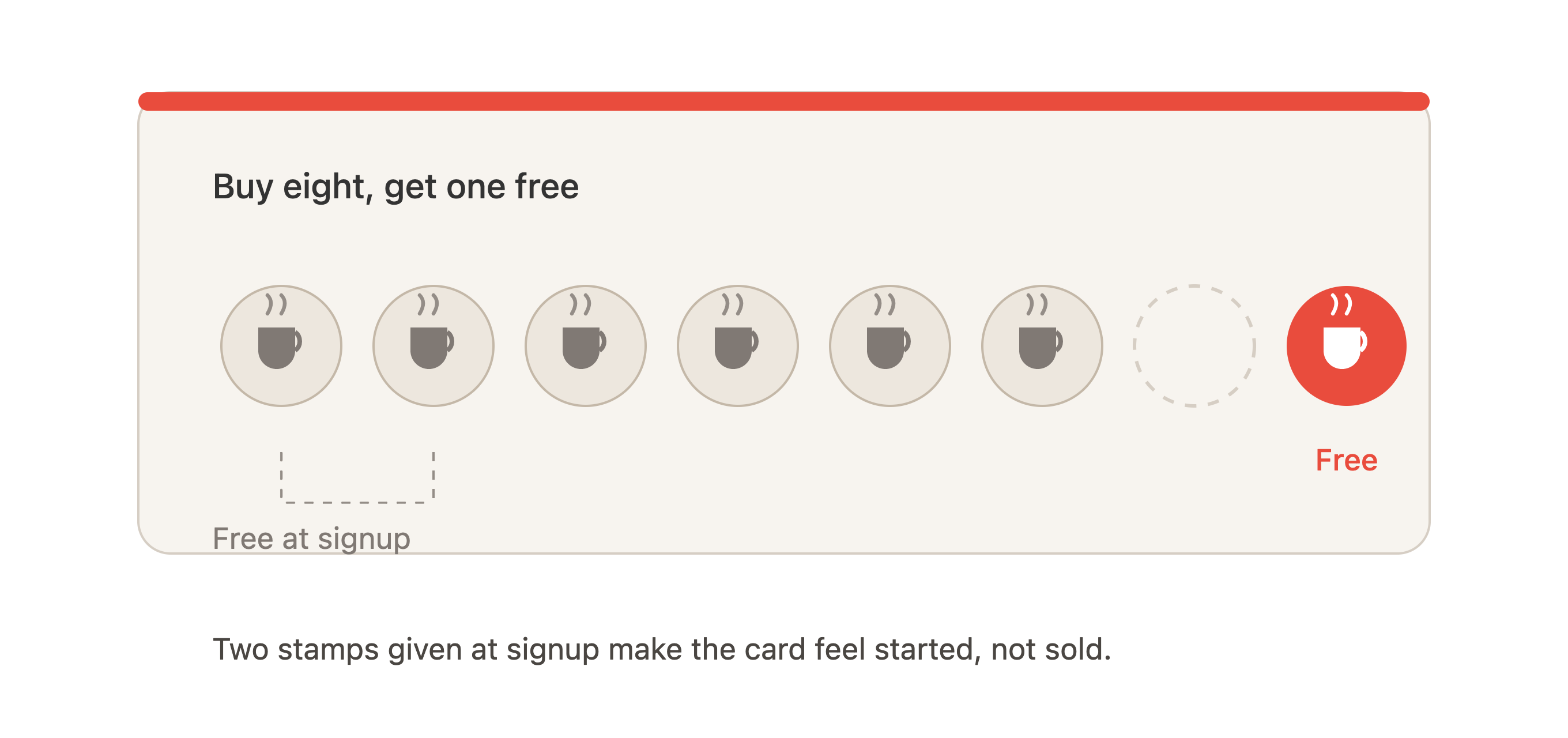
Get the count right. Six to ten stamps is the working range, with eight the most commonly cited sweet spot. Under six and you are giving away margin to people who were coming anyway. Over ten and the reward is too far away to pull anyone — if it takes twenty visits, customers stop tracking it, and a program nobody tracks is just a discount you pay for eventually.
Calibrate to your actual visit frequency, not to what sounds generous. A cafe whose regulars come twice a week needs a shorter card than one whose regulars come daily.
The one trick worth using. Give new members a head start — one or two stamps already filled at signup. This is the endowed progress effect, and it is well documented in loyalty design: people finish things they have already started. Reported completion lifts are large, in the region of 80%. It costs you the same free coffee either way, and it converts "someday" into "almost there."
Best for: independent cafes, simple menus, under roughly 100 customers a day, regulars who buy the same thing.
2. The coffee subscription — for cafes with genuine daily regulars
A flat monthly fee for a drink a day, or a set number of drinks a month.
This is the structure that has moved fastest since Pret proved it at scale, and it is fundamentally different from the other two. A loyalty card rewards people for coming back. A subscription charges them to come back — and then makes them feel clever every time they use it.
Two things it does that a stamp card cannot:
It pays you in advance. Revenue arrives at the start of the month rather than a rupee at a time. For a business with thin margins and fixed rent, predictable cash is worth something on its own.
It moves the decision. A subscriber walking past your door has already paid. Going to the cafe across the road now costs them money. That is a much stronger hold than eight stamps.
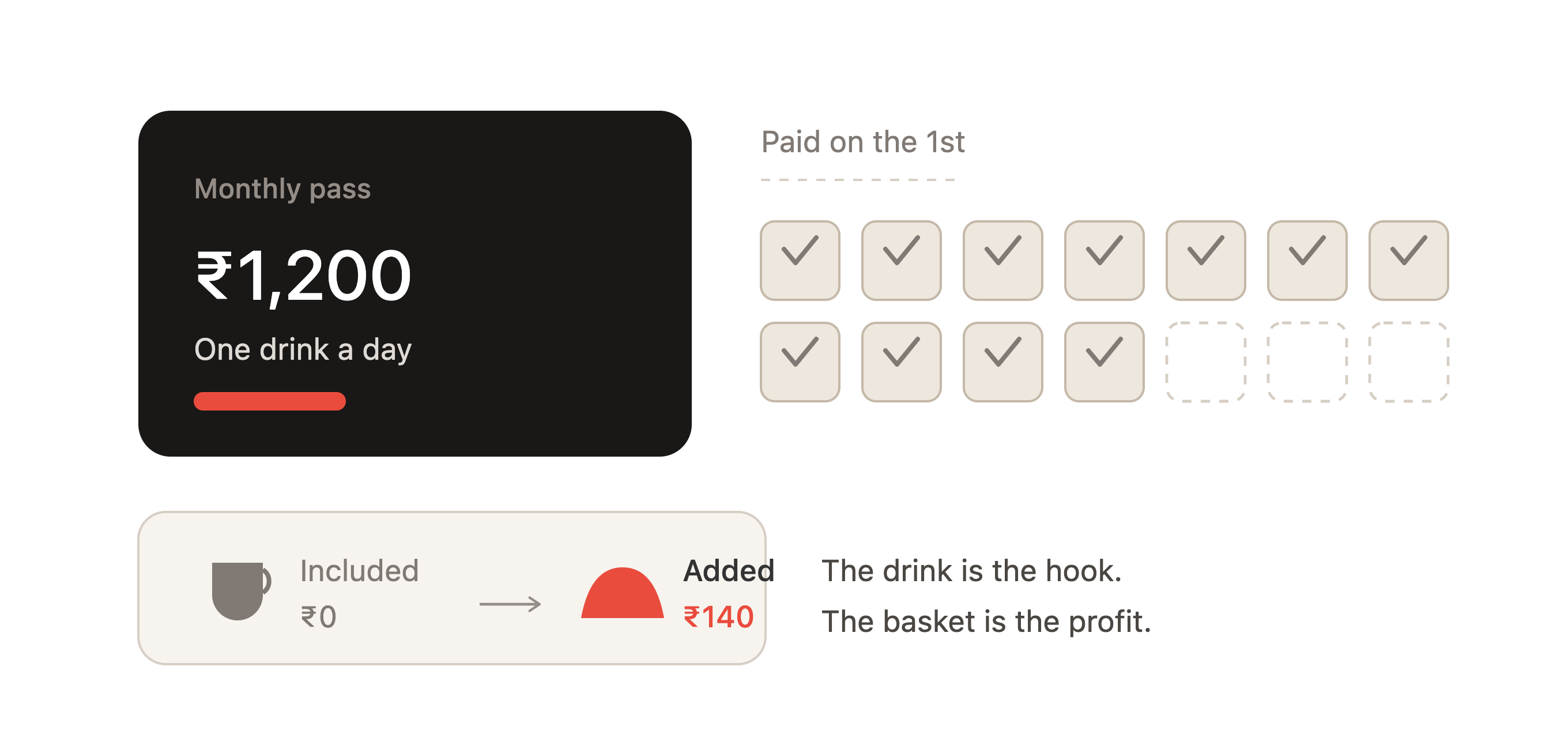
Where the money actually is. Not the coffee — the basket. A subscriber comes in for their "free" drink and adds a croissant, a second coffee for a colleague, beans for home. The subscription is the hook; the attachment is the profit. Model your economics on the whole basket, or the maths will look alarming and you will price it wrong.
The risk is real. Price it badly and you have sold unlimited coffee below cost to your heaviest users — the exact people who cost you most. Before launching, look at your own data: what does your top decile of customers actually consume in a month? Price against that, not against the average.
Best for: cafes with a genuine daily rhythm — office districts, transit locations, campus-adjacent, anywhere people are walking past you at the same time every weekday.
3. Points — for cafes that are also selling food and beans
Points per rupee spent, redeemable against a menu of rewards.
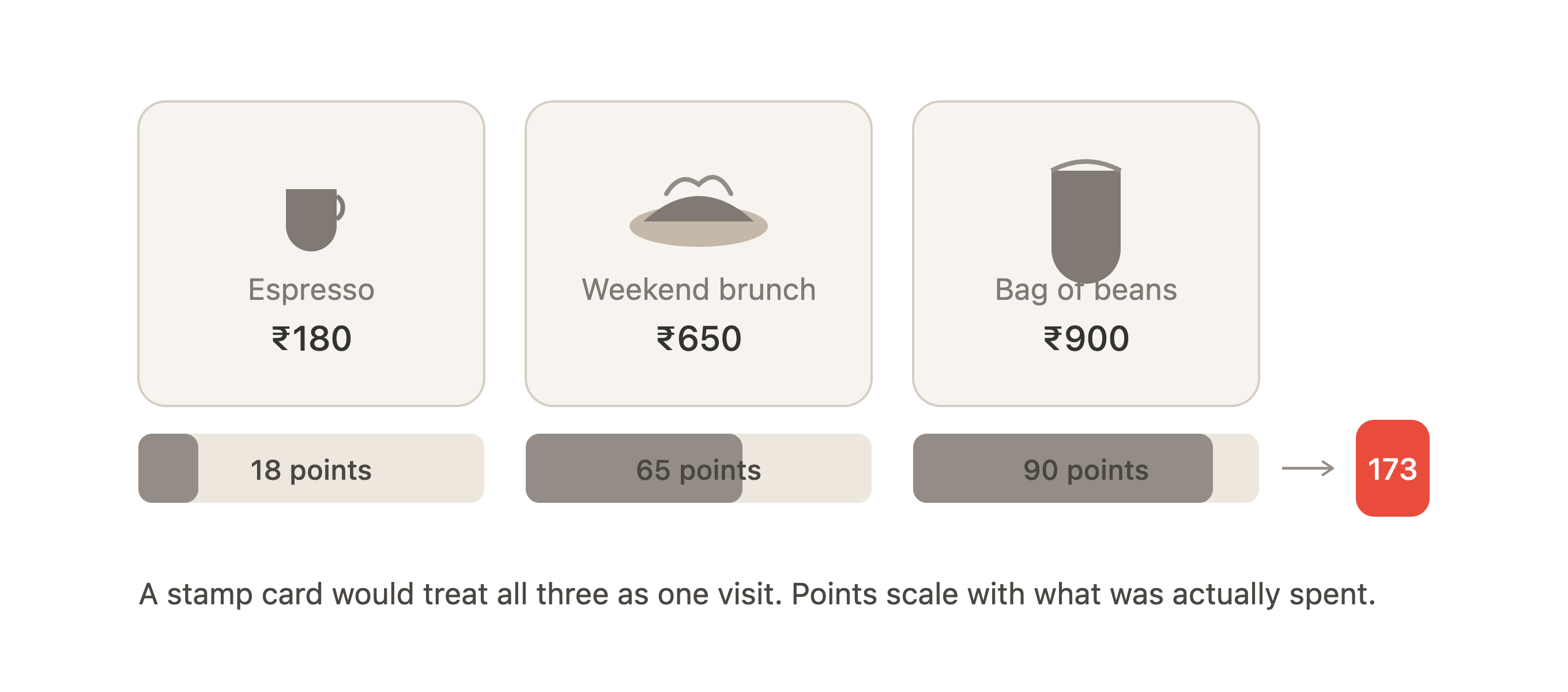
Points are more complex than stamps and worth it only in one situation: when your basket varies a lot. A stamp card treats a ₹180 espresso and a ₹650 brunch as the same transaction, which either overpays the espresso drinker or insults the brunch one. Points scale with spend, so they stay fair across both.
They also handle retail cleanly. If you sell beans, equipment or merchandise alongside drinks, points let one program cover everything without separate rules.
The cost is comprehension. Stamps explain themselves. Points need a conversion rate, a redemption threshold and a rewards menu, and every one of those is a thing your customer has to learn and your staff has to explain. If your barista cannot describe the program in one sentence during a rush, your customers will not understand it either.
Best for: higher-volume cafes, roughly 100+ customers a day, mixed food and drink menus, retail attached.
Which one is yours
A rough decision rule:
- Simple drinks menu, under 100 covers a day → stamp card.
- Daily regulars, predictable weekday rhythm → subscription, priced off your heaviest users.
- Mixed food and drink, retail, higher volume → points.
- Not sure → stamp card. It is the easiest to run, the easiest to explain, and the easiest to abandon if it does not work.
The hybrid is also legitimate and increasingly common: a free stamp card for everyone, plus a paid monthly pass for the people who come daily. Customers self-select, and you capture both groups without forcing either into the wrong scheme.
Why most cafe loyalty programs die
Almost never because the reward was wrong.
Paper. Punch cards get lost, live in a coat pocket, and go through the wash. Digital cards on the phone reportedly lift redemption several times over with no change to the underlying offer — same "buy nine get one free," different result, because the card is now on the device your customer checks constantly.
Asking for an app download. This kills programs faster than anything else. Nobody is installing an app for a neighbourhood cafe. The signup has to happen at the counter in one step, with no store visit and no password.
In India, this points somewhere specific. Wallet passes work well in markets where Apple and Google Wallet are habitual. Here, the thing every customer already has open is WhatsApp, and the identity they already use for payment is their phone number. A program that lives on a phone number and communicates over WhatsApp fits the market better than one that assumes an app install.
Nobody was told. Programs get explained verbally, once, by whoever is on shift. Put it on a counter card, on the menu board, and near the pickup point. If it exists only in your barista's memory, it exists on the days that barista is working.
Staff cannot explain it. Three rules, one sentence. If enrolling someone takes longer than making their coffee, it will not happen during the morning rush, which is when your best customers are standing there.
It was launched and never looked at again. After two weeks, check enrollments, visit frequency and who has gone quiet. A loyalty program with no one reading the data is a discount scheme.
About those numbers
You will see a lot of confident statistics on this topic — 47% more repeat visits, 67% higher spend, 74% of operators running a program. Most of them are published by companies selling loyalty software, and almost none disclose their method or sample.
The direction is credible and consistent across sources. The precision is not. Use these figures to decide whether to try something, never to forecast what it will return.
Your own numbers are better than any of them. Before you launch, write down your current repeat rate and average basket. Ninety days later, look again. That single comparison is worth more than every benchmark in this post.
Start here
Pick one structure. Run it for ninety days without changing it. Measure two things: what share of transactions are enrolled members, and whether your regulars are visiting more often than they were.
If enrollment is low, your signup is too hard. If enrollment is high but frequency is flat, you are rewarding people who were already coming — shorten the card or change the reward.
Both are fixable. What is not fixable is a program nobody joined because it needed an app.
Statistics referenced are drawn from published industry sources including Square's 2026 Future of Commerce report and Bain & Company retention research, alongside vendor-published benchmarks that should be treated as indicative rather than measured. Accurate as of 24 August 2026.