
Settling the Bill at the Table: How ChefDesk Does UPI Without Extra Hardware
Your captain walks to the cashier and back for every bill. ChefDesk settles it at the table over UPI, on the phone they already carry. No extra hardware.
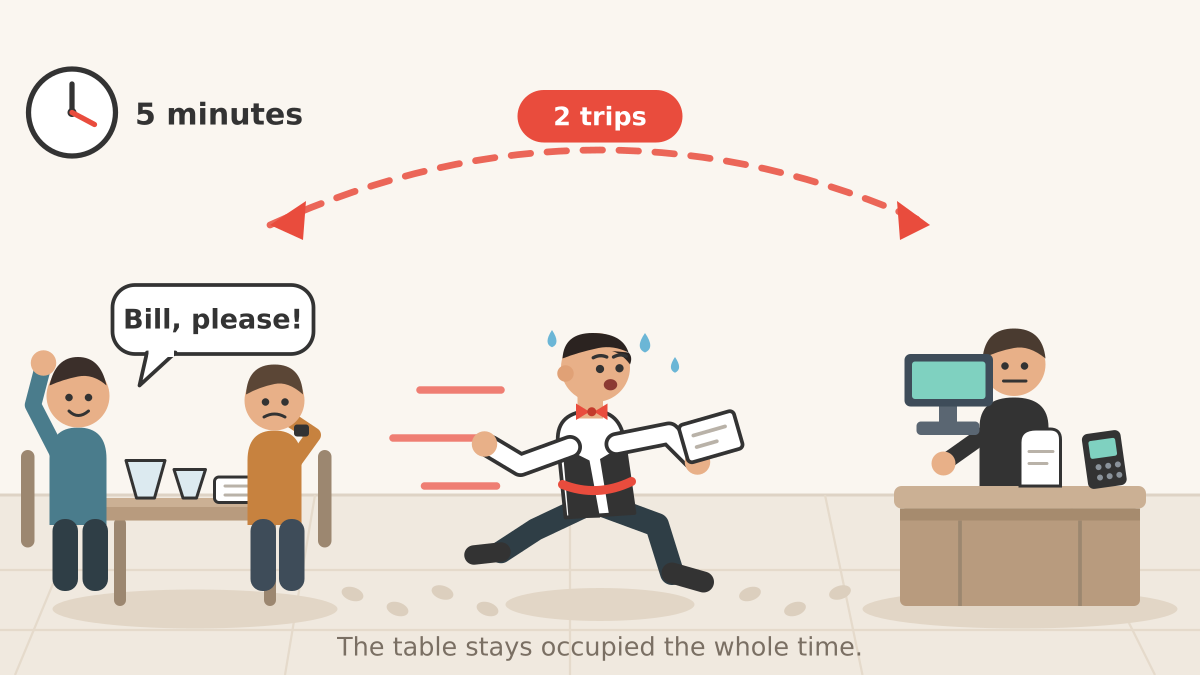
There is a moment at the end of every meal in a full-service Indian restaurant that nobody has ever enjoyed. The guest asks for the bill. The captain walks to the counter. The cashier prints it. The captain walks back. The guest looks at it, hands over a card or asks where to scan. The captain walks to the counter again, or goes to find the card machine, which is currently with another captain on the other side of the floor. Somewhere in there the guest has stopped talking and started waiting.
On a busy Saturday that round trip happens sixty times. Each one takes four to six minutes of elapsed time, most of which is the table sitting occupied and unproductive after the guests have mentally left.
ChefDesk now closes the bill where the guests are sitting, paid by UPI, on the same phone the captain already used to take the order. No walk to the cashier. No hunting for the card machine. No second device.
What "tableside settlement" actually means, because everyone claims it
The phrase covers at least five different things in the Indian market, and they are not equivalent. Worth being precise, because the differences decide whether your reconciliation is clean at closing.
A static QR sticker on the table or the wall. The guest scans, types the amount themselves, and shows the captain their success screen. Cheapest possible option and by far the most common. It is also the worst: the amount is typed by hand so it is sometimes wrong, the payment carries no reference to the bill, and the only proof your POS ever gets is a captain tapping "paid" because a guest showed them a screenshot. Reconciliation at closing is a manual matching exercise, and it is a well-known leakage route.
A soundbox. Confirms payment with an audio announcement, which solves the fake-screenshot problem. It does not solve the reconciliation problem, because the soundbox is not talking to your POS. It is also one more rented device per floor, and it is loud in a dining room.
An EDC card machine carried to the table. Works, and guests are used to it. But it is a rented terminal, it has its own battery and its own network, there are never enough of them for the number of captains, and the settlement still has to be matched back to the bill by someone at the end of the night.
The guest pays from their own phone. A QR or link takes them to a hosted page, they pay, the system knows. Clean, and this is essentially where DotPe came from. It works well when the guest is already holding their phone, and less well at a table of eight where one person is paying for everyone and would rather just hand something over.
The captain's own device becomes the payment point. The bill is generated on the captain's phone, a payment request for the exact amount goes out from that phone, confirmation comes back to that phone, and the table closes in the POS. No additional hardware anywhere in the chain.
That last one is what ChefDesk built.
How it works in ChefDesk
The captain is already holding the device. They took the order on it and sent the KOT from it. When the guests ask for the bill:
- The captain pulls up the running table on the same phone and closes the order.
- ChefDesk generates the bill with the exact amount, GST calculated, and raises a UPI payment request for that amount tied to that bill number.
- The guest pays from whichever app they use. Nothing is typed by hand, so the amount cannot be wrong.
- Confirmation comes back against that bill. The table is marked settled in the POS and released for the next party.
- The GST invoice goes to the guest's WhatsApp, or prints, or both.
The sequence matters more than it sounds. Because the payment is raised against a specific bill and the confirmation lands against that same bill, the day's UPI collections reconcile to the day's bills without anyone matching anything by hand at midnight. That is a different thing from a captain marking a bill paid on the strength of a screenshot, and the difference shows up in your cash position, not just in your convenience.
It runs on ordinary Android phones. Any brand sold in the market, the same devices your captains are already carrying for order-taking. ChefDesk does not sell hardware, does not certify a shortlist, and does not rent you a terminal, which means adding a sixth captain during a festival week is a matter of installing the app on a sixth phone.
Where this sits against Petpooja and DotPe
Let us be straight about this, because a comparison that pretends the competition can't do something they demonstrably can is worthless to the reader and embarrassing when they find out.
Tableside UPI settlement is not unique to ChefDesk. Several Indian platforms do it, and some have done it for a while. What varies is the architecture, what it costs you in hardware, and how much of it is a paid add-on.
| Tableside UPI settlement | Runs on the captain's existing phone | Extra hardware needed | Notes | |
|---|---|---|---|---|
| ChefDesk | Yes | Yes, any Android brand | None | Same app as ordering and billing; no hardware sold or rented by the vendor |
| Petpooja | Yes | Yes | None for UPI | Captain App settles UPI, card tap under ₹5,000, and cash at the table; sits in their Marketplace add-on structure alongside Petpooja Pay+ and EDC partnerships |
| DotPe | Yes | Partly | None | Architecture is guest-phone-first; their waiter app handles bill approval and payment notifications rather than being the payment point itself |
| Much of the rest of the market | Sort of | No | Soundbox, dynamic-QR box, or rented EDC | Payment happens near the table, but outside the POS, so reconciliation stays manual |
Petpooja is the incumbent benchmark here and it is a real one. Their Captain App lets a captain pull up the bill on the same device and settle it at the table by UPI, card tap for transactions under ₹5,000, or cash, and they are running at a scale — by their own published figures, upwards of 60 lakh bills a day across more than a lakh of outlets — that means the flow is well-tested. Anyone telling you Petpooja makes captains walk to the counter has not used it.
DotPe comes at the same problem from the opposite end. The company grew out of QR ordering and payment links, so its instinct is to put the transaction on the guest's phone, with the restaurant's waiter app receiving the notification and approving the bill. For casual formats and for guests who are already ordering from their own phones, that is arguably the better shape. For a fine-dining room where the captain is the entire service interface, it is a slightly awkward fit.
So what is actually different about ChefDesk? Three things, and none of them is "we invented this."
One, there is no hardware relationship at all. ChefDesk does not sell, lease or certify devices. The captain's phone is a phone you bought at a shop, and the payment happens on it. There is no rented soundbox on the floor, no EDC deposit, and no clause anywhere that turns a device into a paperweight if you stop subscribing. For a fifty-cover restaurant running four captains, the hardware line item for tableside settlement is zero.
Two, it is part of the same app, not a module you buy. The captain takes the order, fires the KOT, prints or WhatsApps the invoice, and settles the bill in one place. Nothing to switch into, nothing separately priced per device.
Three, the confirmation closes the table, not the captain. The POS learns that the bill was paid from the payment confirmation, not from a member of staff asserting it. That is the part that matters six months in, when you are trying to work out why the UPI total and the bill total disagree by ₹4,000 a week.
What changes in the restaurant
Table turns. The round trip to the counter disappears. In a room doing two sittings on a Saturday, five minutes per table compounds into real covers. This is the benefit owners feel first.
Leakage closes. Bills settled on a screenshot are a known problem. When the payment carries a bill reference and the confirmation lands in the POS, that particular hole shuts.
Closing gets shorter. UPI collections already match the bills. The day-end exercise becomes checking the cash drawer rather than reconstructing a payment log.
Captains stay on the floor. A captain walking to the counter twice per table is a captain not refilling water, not clearing plates, and not selling dessert. This is the same logic as kiosks in QSR: the technology does not remove staff, it stops them doing the low-value walking.
Guests leave when they want to. The gap between asking for the bill and being able to leave is one of the most reliably irritating parts of eating out in India. Closing it is worth more to a repeat customer than most loyalty programmes.
The context is that UPI is no longer one payment method among several. It handles the majority of India's digital transactions, running well past 14 billion transactions a month as of early 2026. In most restaurants it is already the largest single tender. Designing your settlement flow around anything else is designing around the exception.
Limitations
A few things to know before you assume this solves everything.
UPI needs a live connection at the moment of payment. ChefDesk bills offline by default — the local database on the device means orders, KOTs and invoices keep working with the internet completely down. Payment confirmation cannot. If the outlet's connectivity drops mid-service, billing continues, but UPI settlement waits or falls back to cash. Anyone claiming offline UPI is describing something else.
A table of eight splitting six ways is still a table of eight splitting six ways. Software makes it faster, not pleasant. Decide your house policy before rollout.
Tips over UPI need a deliberate decision. If tipping is part of your service culture, work out whether it goes into the payment request or stays in cash, and tell your captains, because they will otherwise decide for you.
The phone is now a payment device, which changes how you treat it. Screen condition matters if guests are scanning from it. Battery matters more when settlement depends on the device surviving the full shift. Neither is difficult, but both need a routine.
Failed and pending transactions exist. They are rare and they are usually resolved in minutes, but a captain needs to know what to do in the thirty seconds when the guest's app says one thing and the POS says another. Train for it once and it never becomes a problem.
The short version
Tableside UPI settlement is not a new idea, and ChefDesk is not the first to build it. Petpooja and DotPe both have a version of it, and so do others. Anyone telling you otherwise is selling.
What ChefDesk is doing is making it the default rather than an add-on, running it on whatever Android phone your captains already carry, with no rented soundbox, no EDC deposit, no certified device list, and no hardware relationship with us at all — and letting the payment confirmation, rather than a member of staff, be the thing that closes the table.
If your captains are still walking to the cashier, that is the part worth fixing, whichever product you fix it with.
Want to see it on your own menu? Book a demo and we will set it up on a phone you already own.