
Room Charges Without the Paper Chit: ChefDesk and Kubicale, Integrated
A guest signs for lunch and walks out. Somewhere between the restaurant printer and the front desk, that chit has to become a line on their folio. Most hotels move it by hand and lose some of it.

In short: In most hotels, a restaurant bill reaches the guest's room account by hand — printed, signed, carried to the front desk and keyed in again. Every step is a chance to lose the charge or post it to the wrong room, and a charge that arrives after the guest has checked out is usually written off. ChefDesk and Kubicale are both Zaravya products, and they now talk to each other directly: restaurant and kitchen orders post to the room folio without re-keying at checkout.
The journey a restaurant bill takes
Picture a hotel with 60 rooms, a coffee shop, a bar and room service.
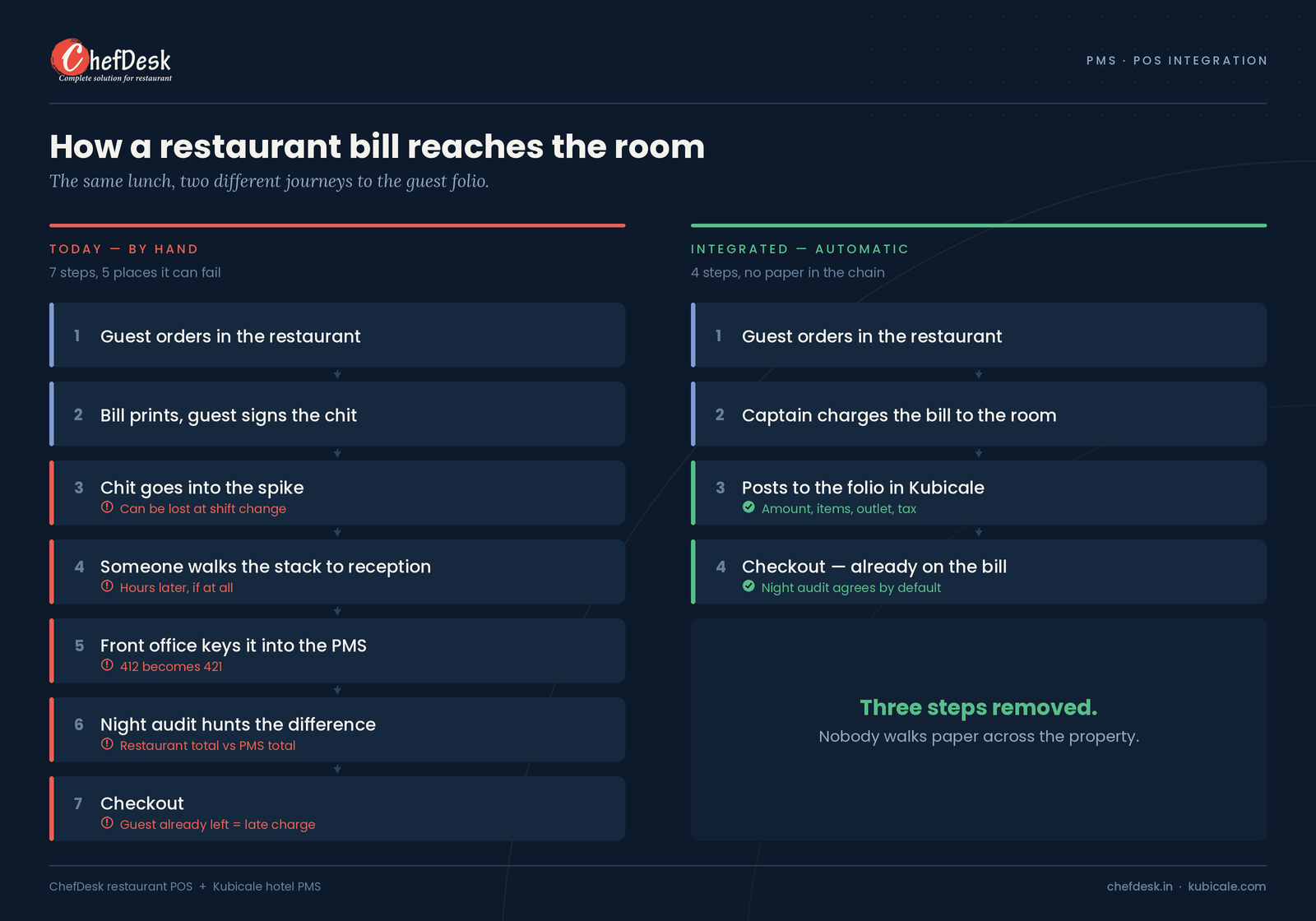
A guest in 412 has lunch. The captain settles the bill to the room. The printer produces a chit. The guest signs it. Now that piece of paper has to become a line on the guest's folio before they check out tomorrow morning.
What usually happens next: the chit sits in a spike by the restaurant till. At some point in the afternoon, someone walks a stack of them to the front desk. A front office associate types each one into the PMS — room number, amount, outlet, tax. Then the night auditor reconciles the restaurant's day-end total against what was posted, and investigates the difference.
That is the good version. The ordinary version has gaps in it.
Where the money goes
Chits that never arrive. A stack gets left under the till through a shift change. Nobody notices until the night audit, and by then the guest may have gone.
Posted to the wrong room. 412 becomes 421. Two guests are now unhappy: one who paid for someone else's lunch, and one who got a free one.
Late charges. This is the costly one, and it has its own name in hotel accounting. A charge that reaches the folio after the guest has settled and left is a late charge. Most hotels write off small ones rather than chase a departed guest for ₹600, because the recovery effort costs more than the amount. Breakfast on departure morning is the classic case: the guest eats at 7:40 and checks out at 8:15, and the chit is still in the restaurant.
Disputes at checkout. A guest queries a charge. The front desk can see an amount but not what was ordered. Someone walks to the restaurant to find the chit while a queue forms.
Double entry. Every bill is keyed twice — once in the POS, once in the PMS. That is a real labour cost and a real error rate, and it scales with occupancy.
None of this is exotic. It is the ordinary consequence of two systems that do not know about each other.
What Kubicale is, briefly
If you have arrived here from the restaurant side, some context. Kubicale is Zaravya's cloud hotel management system — the PMS that runs the rooms side of a property.
The parts that matter to this article:
- Front desk — a live availability board, drag-to-move stays where rates and folios follow the guest, ID scanning at registration, and folio split, merge and transfer
- Billing — GST-ready invoices, credit notes, advance receipts, night audit, card/UPI/cash reconciliation, and export to Tally or QuickBooks
- Housekeeping — room status from any phone, departures queued in checkout order, faults that open maintenance jobs
- Rates and channels — distribution across 40-plus channels, Google Hotels listing, rate rules and an overbooking guard
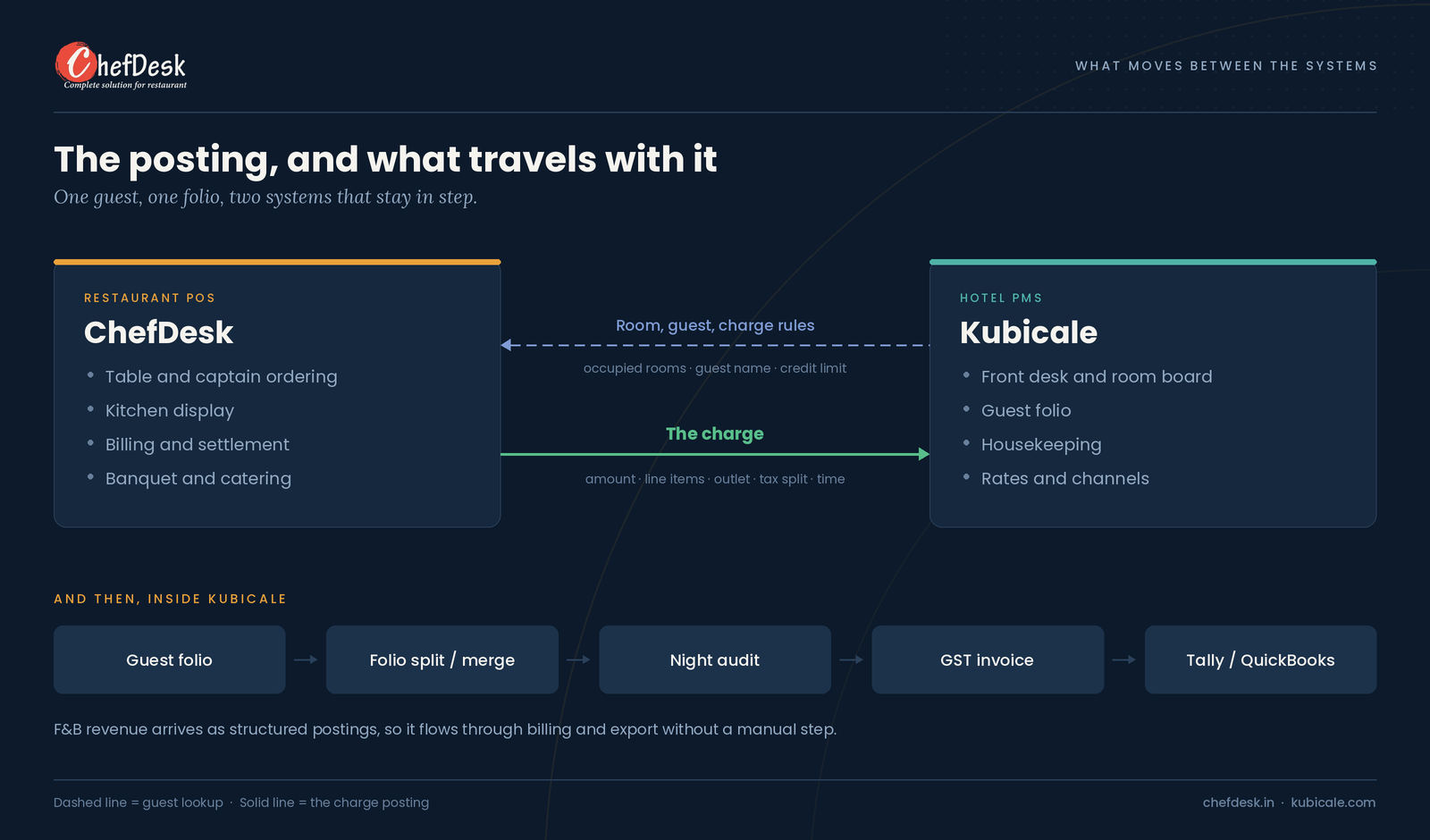
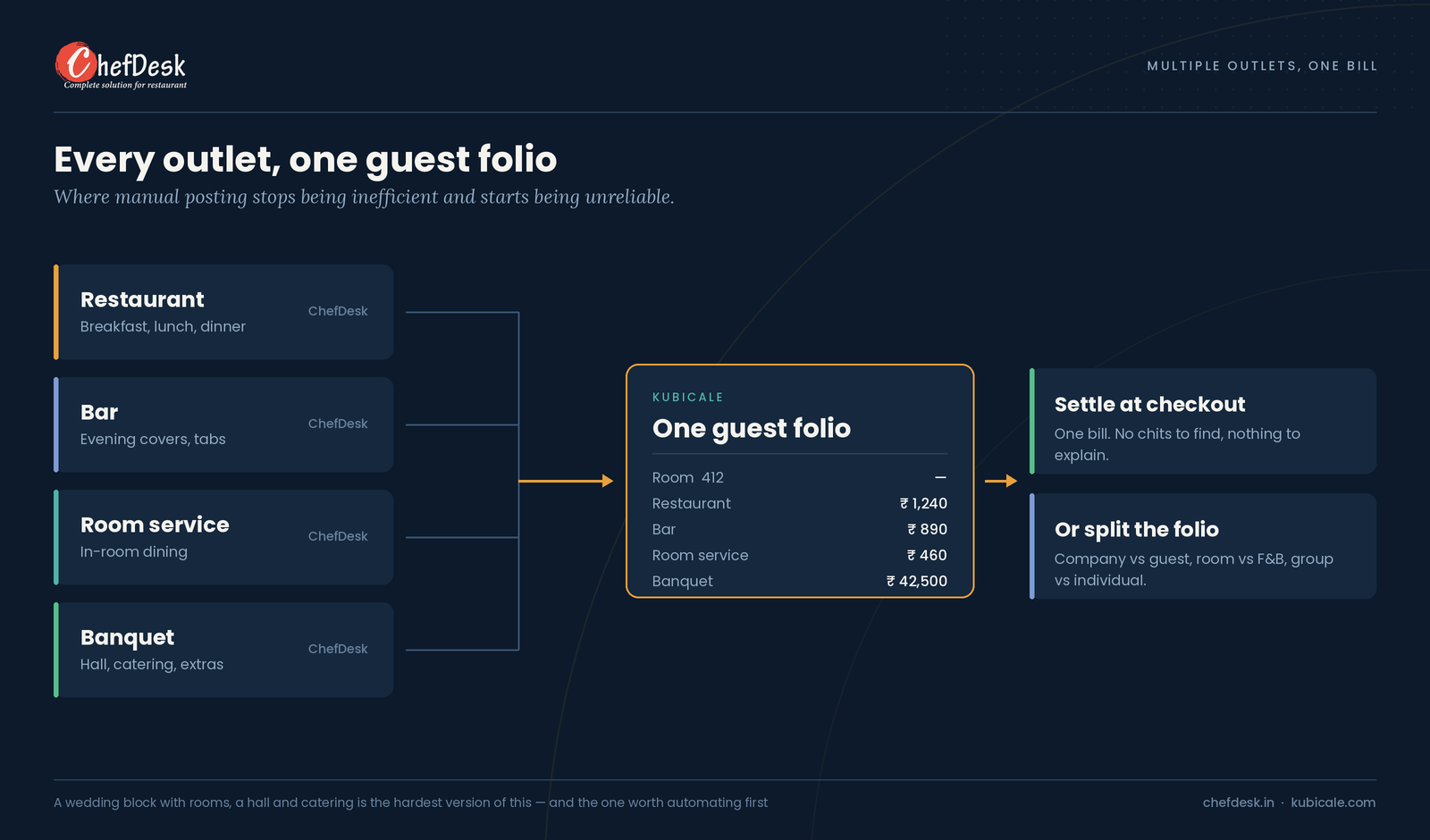
Folio split, merge and transfer is worth drawing out, because it is the feature that makes restaurant posting genuinely useful rather than merely automatic. A business guest who wants the room on the company account and dinner on their own card is two folios against one stay. A wedding party with eight rooms and a group dinner is a different arrangement again. The posting has to land on the right one, and the splitting has to still work after it does.
What changes when the systems are connected
With ChefDesk and Kubicale integrated, the sequence collapses.
The captain charges to the room. The bill posts to the folio in Kubicale — amount, outlet, items, tax head — without anyone keying it a second time.
The front desk sees it. At checkout, the folio already has the lunch on it. If the guest queries it, the detail is there rather than on a chit in another building.
The night audit becomes a check rather than a reconstruction. The restaurant's day-end and the PMS F&B revenue already agree, because they came from the same posting.
Reconciliation and export stay intact. Kubicale's billing already handles GST invoicing, night audit and export to Tally or QuickBooks. F&B revenue arriving as structured postings rather than retyped totals means it flows through that chain without a manual step in the middle.
The chit still prints if you want it to — a signature is useful for dispute protection. But it stops being the mechanism by which the money travels. It becomes a receipt rather than a courier.
The part most comparisons skip: tax
If your hotel restaurant is inside what Indian GST rules call specified premises, this matters more than any feature in the integration.
The rule as it stands: restaurant service supplied at specified premises attracts 18% GST with input tax credit. Restaurant service outside specified premises attracts 5% without input tax credit. Since 1 April 2025, whether a hotel counts as specified premises turns on the actual value of accommodation supplied in the preceding financial year — above ₹7,500 per unit per day — rather than the older "declared tariff" test. There is also an opt-in and opt-out declaration to be filed between 1 January and 31 March of the preceding financial year, and the CBIC has said those timelines are strict, with no grace period.
Why this breaks things in practice:
A standalone restaurant POS assumes 5% without ITC, because that is correct for most restaurants. Drop that same POS into a hotel that qualifies as specified premises and every bill it prints is taxed wrongly. The error compounds daily, it is invisible until an audit, and the input credit position is wrong too.
There is a structural point here as well. The determination depends on accommodation values — which is PMS data. In a property running separate systems, the restaurant POS is configured blind to the number that decides its own tax treatment, and nothing re-checks it when rates move across a financial year. In a property where the two systems are connected, that information at least lives in one place.
Confirm your own position with your CA. The specified premises rules changed in 2025 and the declaration windows are unforgiving.
Why same-vendor integration is different
There is an argument here worth making plainly, because it is the actual commercial point.
Most PMS–POS integrations are between two companies. That arrangement has three predictable problems.
You often pay twice. Hotel software vendors commonly charge an interface fee for connecting a third-party POS. The POS vendor may charge for its side too. You are paying two companies for one connection that neither considers core to its product.
Support becomes a triangle. A posting fails. The PMS vendor says the POS sent a malformed request. The POS vendor says the PMS rejected a valid one. You hold both support tickets, translating between two teams with no commercial reason to resolve it quickly.
Upgrades break things. Either vendor can ship a change that breaks the interface, and neither tested against the other. You find out at 9pm on a Saturday.
ChefDesk and Kubicale are both Zaravya Informatics products. The integration is built and maintained by the people who build both ends of it. One support line, one roadmap, nobody to point at.
That is not a claim that either product is better than its competitors. It is a claim that the connection between them is somebody's actual responsibility — which, with two vendors, it frequently is not.
The same logic extends across the rest of the stack. Kubicale also integrates spa and wellness, staff and payroll, loyalty and CRM, alongside Tally, Zoho, Odoo, QuickBooks and GST e-invoicing. For a property with several revenue centres, the question is less about any single connection than about how many separate vendor relationships you want to maintain for your guest to receive one bill.
What to check in any PMS–POS integration
Whether you are evaluating this one or somebody else's, these questions separate a real integration from a nightly file transfer.
Is posting real-time or batched? A batch that runs at midnight does not prevent the departure-morning late charge. Real-time does.
Can the POS verify the guest before charging? It should know whether the room is occupied, who is in it, and whether that guest may charge to the room. Not every guest can — walk-ins, cash bookings and some corporate rates often cannot.
Does it handle credit limits? A folio with a limit should stop accepting charges past it at the point of sale, not at checkout.
Does item-level detail travel, or just a total? A total is enough for accounting and useless for a dispute.
Does it post to the right revenue head? Restaurant, bar, room service and banquet are separate revenue centres in any serious hotel P&L. If everything lands in one bucket, your F&B reporting is fiction.
Does it survive folio operations? If a guest's folio is split or transferred after a charge has posted, the charge should move correctly with it.
What happens when the connection drops? The restaurant cannot stop serving because the network did. There should be a queue that posts when the link returns, and a visible record of anything that failed.
Can a posting be reversed cleanly? Correcting a mistake should leave an audit trail in both systems, not a silent edit in one.
Who supports it? Ask before you buy, not after the first failure.
Who this is for
Kubicale's plans give a reasonable guide to the fit. The Desk plan covers guest houses and small properties up to 25 rooms at ₹149 per room per month. The Property plan, at ₹249 per room per month, is the tier that includes restaurant and spa outlets. Group pricing is custom.
That maps to the practical answer:
Hotels with one or more F&B outlets. The economics scale with occupancy and with how much your guests actually eat on property. A business hotel where most guests take breakfast and some take dinner is exactly where manual posting leaks most.
Resorts and properties with multiple outlets. Restaurant, bar, pool service and in-room dining all posting to the same folio is where manual handling stops being merely inefficient and becomes unreliable.
Properties with banquet operations. A wedding block with rooms, a hall and catering spread across several folios is the hardest version of this problem and the one where reconciliation errors are largest. If you run banquets, ChefDesk's banquet module and Kubicale's room inventory are the two halves of the same booking.
Where it matters less. A room-only property with no F&B does not need this. Neither does a restaurant with no attached accommodation. If your hotel's restaurant is leased to a third party and settles independently, the integration solves a problem you do not have.
Getting started
Kubicale quotes roughly a week to go live on the PMS itself. Connecting the restaurant is a mapping exercise rather than a project:
- Connect the two systems and authenticate.
- Map outlets to revenue centres — which ChefDesk outlet posts to which Kubicale head.
- Confirm the tax configuration, including your specified premises position.
- Set charge rules: which rate plans and guest types may post to a room, and any credit limits.
- Run a parallel day. Post live, and also reconcile manually, once. Then stop doing it manually.
That last step is worth insisting on. One day of double-checking buys the front office the confidence to stop walking chits, which is the behaviour change that actually captures the revenue.
The short version
The gap between your restaurant and your front desk is currently crossed by a person carrying paper. That person is reliable most of the time, which is the problem — most of the time is where late charges, misposted rooms and checkout disputes live.
Connecting the two systems does not make the restaurant better or the front desk faster. It removes a step that was never adding anything, and stops a small, steady leak that nobody has put a number to because it never appears as a line item anywhere.
Kubicale features, plans and pricing are taken from the Kubicale site as published on 12 October 2026: https://www.kubicale.com/ — including the Desk plan at ₹149 per room per month up to 25 rooms, the Property plan at ₹249 per room per month including restaurant and spa outlets, the folio split/merge/transfer and night audit capabilities, Tally and QuickBooks export, and the statement that restaurant and kitchen orders post directly to the room folio without re-keying at checkout.
The operational material — late charges, folio posting, night audit reconciliation, revenue centre mapping, interface fees between PMS and POS vendors — is standard hotel operations practice rather than research findings, and is stated from domain knowledge rather than cited. Where a figure would have been useful, such as what late charges cost a property annually, no reliable public data exists, so none is quoted.