
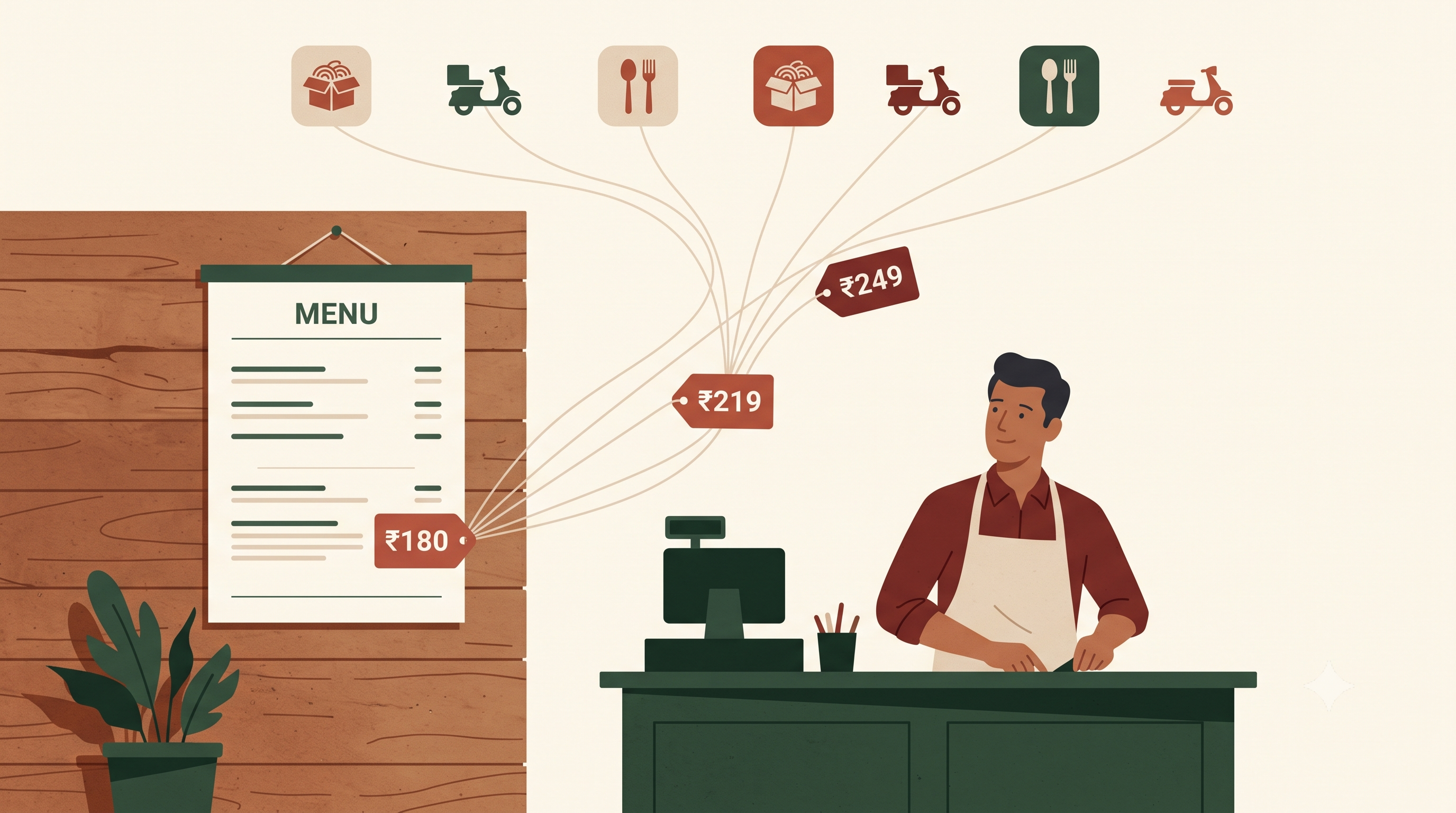
Nobody Decided to Raise That Price
How aggregator commissions quietly rewrite your menu — and why the change only ever moves one way.
Pull up a photograph of your menu from eighteen months ago. Most owners have one somewhere — a launch post, a WhatsApp forward, a photo taken to send to the printer.
Compare it, line by line, with the menu on your tables today.
The prices have moved. Not dramatically, and not all at once. Twenty rupees here. Thirty there. A dish quietly repositioned from ₹320 to ₹380 across three or four adjustments, none of which felt like a decision at the time.
Ask the owner when they raised prices and you will usually get a vague answer. There was the year onions went mad. There was the gas revision. There was the time the aggregator dashboard was updated and the table menu was left to catch up later.
What almost nobody says is: in March I decided this dish would cost nineteen percent more.
Because nobody decided that. It happened.
There is a mechanism behind it, and once you can see it, you cannot unsee it on your own menu.
It begins with arithmetic that looks simpler than it is
A restaurant signs up with a delivery platform. The commission, depending on city, cuisine, volume and how hard the owner negotiated, lands somewhere in the region of 18 to 28 percent of order value. Stack on GST, payment charges, and the discounts the restaurant is expected to fund, and the effective deduction commonly reported by operators sits closer to a quarter or a third of the order.
So the owner does the obvious thing. They mark up the delivery menu to cover the commission.
And here is where the first error enters — an error so common it is almost universal.
Suppose a dish sells for ₹320 on the table, and the commission is 30 percent. The instinct is to add 30 percent. List it at ₹416, and you are square.
You are not square. You are losing money on every single order.
The platform deducts its commission from what the customer pays, not from what you wanted. List at ₹416, and you receive ₹416 minus 30 percent — which is ₹291.20. You have just sold a ₹320 dish for ₹291.20.
You are short by ₹28.80. On forty delivery orders a day, that is about ₹1,150 a day, or roughly ₹34,500 a month, leaking from a decision the owner believed had solved the problem.
To actually stay whole, you have to mark up from the net, not to it:
| Effective commission | Markup required to keep the same net |
|---|---|
| 20% | 25% |
| 25% | 33% |
| 28% | 39% |
| 30% | 43% |
| 35% | 54% |
At 30 percent commission, that ₹320 dish has to be listed at ₹457 — not ₹416 — before the kitchen sees the same money it sees from a walk-in guest.
Very few menus reflect that. Most sit somewhere between the naive markup and the correct one, which means most restaurants are quietly cross-subsidising their delivery channel out of their dine-in margin without ever having chosen to.
Then you are running two menus
Whatever number the owner lands on, the outcome is the same: the restaurant now has two prices for one dish.
This works, for a while. Then it starts to grind.
It grinds operationally. Every menu change is now two menu changes. Every promotion has to be reasoned through twice. A new cashier bills the delivery rate to a table, or the table rate to a pickup order, and nobody catches it for a week.
It grinds with guests. Someone sitting at your table opens the app, sees ₹416 next to the ₹320 on the card in their hand, and forms a view about your restaurant that has nothing to do with your food. Occasionally they say so publicly.
And — this is the part that matters most — it grinds on the owner.
Because for month after month, the owner has been looking at ₹416 on a screen. That number becomes familiar. It becomes the number the dish is worth. And ₹320 starts to look, from the inside, like undercharging.
That feeling is not analysis. It is anchoring. But it is powerful, and it does not announce itself as a bias. It arrives as a perfectly reasonable thought: we are underpriced on the floor.
The gap closes — but not the way you would expect
Eventually the two prices converge. Something forces it: a menu reprint, a POS migration, a cost spike that provides cover, or simply the accumulated irritation of maintaining two lists.
Now, in principle, convergence could go either way. The delivery price could come down to meet the dine-in price.
It essentially never does.
The dine-in price goes up. Not all the way to ₹416 — that would feel aggressive. It settles somewhere sensible in between. Call it ₹380.
And on the day that happens, the delivery price is no longer correct. If ₹380 is now what the dish is worth, then at 30 percent commission the platform listing has to become ₹543 to hold the same net.
So the owner raises the delivery price again.
And the cycle restarts — from a floor ₹60 higher than where it began.
This is a ratchet, not a cycle
The distinction is the whole point.
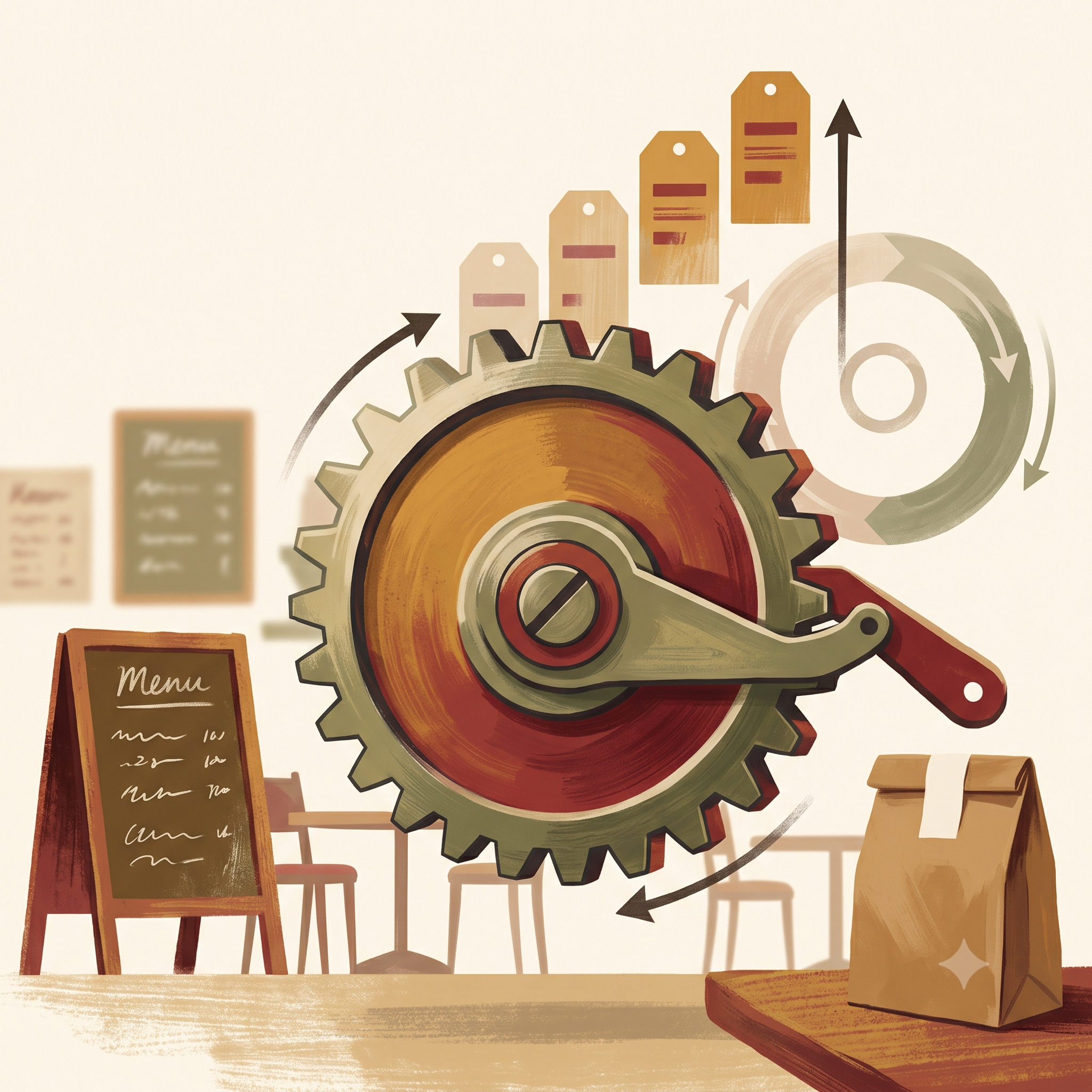
A cycle returns to where it started. This does not. Each turn establishes a new baseline that the next turn builds on. The mechanism only has one direction, because at no stage does anyone have a reason to push a price down.
Look at what two rounds did:
- Dine-in: ₹320 → ₹380
- Delivery: ₹416 → ₹543
The dine-in guest — who has never opened a food delivery app in their life, who walked in, sat down, and paid at your counter — is now paying nineteen percent more than they did. They are, in a precise sense, contributing to the cost of a commission on a transaction they did not make and were not party to.
Nobody set out to do that. There was no meeting. It is an emergent property of solving a commission problem one price at a time, without ever stepping back to look at the sequence.
There is a further twist. Every time the delivery price is raised and orders keep coming, the restaurant has unintentionally run a pricing experiment — and the experiment came back positive. Demand held. That result then licenses the next increase, on both channels. The platform, in effect, becomes the laboratory in which the restaurant discovers its own customers will tolerate more.
Why customers do not notice
Two reasons, and the first is genuinely elegant.
Economists have a term for the expense and friction of changing a price: menu costs. The name is not a metaphor. It comes from restaurants — from the real, physical cost of designing, printing and distributing a new menu.
Menu costs used to enforce discipline. Because reprinting was expensive, prices changed once a year, in a visible chunk, at a moment the customer noticed. The friction was a kind of accountability.
Digital menus, QR codes and aggregator dashboards abolished that cost entirely. A price can now be changed on a Tuesday afternoon, by one person, for free, with no announcement and no artefact left behind. The discipline vanished along with the expense.
The second reason is perceptual. A ₹20 movement on a ₹320 dish is a six percent change, on an item most people order once every few weeks, with no reference price anywhere in view. There is no shelf label, no unit price, no last month's receipt. Six percent, delivered occasionally, sits below the threshold at which most people register that anything has happened at all.
Raise a price by twenty percent overnight and you will hear about it. Raise it by six percent, four times, across two years, and you will hear nothing — and end up higher than the twenty percent would have taken you.
None of this makes aggregators villains
It is worth saying plainly, because the argument is often made badly.
Delivery platforms supply something real: demand, at a scale most independent restaurants could not generate on their own, with no upfront marketing spend. For a young outlet with no footfall, that is not extortion; it is customer acquisition, priced aggressively.
The commission is a channel cost. The failure is not that it exists. The failure is that most restaurants respond to it reactively — adjusting a number when the pressure becomes uncomfortable — rather than deliberately, as a pricing decision with a rationale, a date, and a review.
Reactive pricing is what produces the ratchet. Not the commission.
What actually breaks the cycle
Work in net, not gross. The only number that matters is what reaches your account per order, per channel, after commission, GST, payment charges and your share of any discount. Most owners can quote their menu price instantly and their net per channel not at all. Until that second number is visible, every pricing decision is being made blind.
Decide the gap; do not discover it. If your delivery price is going to differ from your dine-in price, set that difference on purpose, with the correct arithmetic, and write down why. A gap you chose can be defended to a guest. A gap that accumulated cannot.
Treat normalisation as a decision. The dangerous moment is not the markup. It is the quiet convergence months later, when the delivery price silently becomes the new reference. That is a genuine price increase for your dine-in guests, and it deserves the same deliberation you would give any other price increase — including asking whether ₹380 is actually right, or merely the midpoint of two numbers that were themselves arrived at by accident.
Review on a schedule, not on a feeling. Prices reviewed every quarter, against costs and against net-per-channel, move for reasons. Prices reviewed when margins start to feel tight move for anchors.
Build something you own. Every order that arrives through your own counter, your own QR, or your own repeat customer is an order with no commission to engineer around. It will not replace the platforms, and it does not need to. It just needs to be large enough that the platforms are a channel you use rather than the channel you depend on.
The uncomfortable part
Go back to that eighteen-month-old menu photograph.
Somewhere in the gap between that menu and today's is a price increase your guests absorbed without complaint, that you never quite decided to make, driven substantially by a commission on a channel some of those guests have never used.
That is not a failure of ethics. It is a failure of visibility — the entirely ordinary result of solving a problem one number at a time, on a system that made changing numbers free.
The ratchet does not run on greed. It runs on arithmetic that nobody goes back and checks.
ChefDesk gives restaurant operators channel-wise visibility of what actually lands per order — dine-in, takeaway, and each aggregator, net of commissions — so that pricing decisions are made against real numbers rather than remembered ones.