
Offline vs Online Billing Software: Pros, Cons & GST Risks (2026)
Choosing between offline and online billing software affects more than convenience. It shapes your data security, growth potential and GST compliance. We break down the pros and cons of each, explain why some vendors pitch offline billing as a way to avoid tax, and show why that shortcut is a risky bet for Indian businesses.

Offline vs Online Billing Systems: What Every Indian Business Owner Should Know
Walk into almost any shop in Hyderabad, Pune or Surat and ask about their billing setup, and you'll hear one of two answers: "We use software on our computer" or "Everything is on the cloud now." The difference sounds technical, but it has real consequences for cost, convenience, data safety and, increasingly, tax compliance.
This post looks at both options fairly, and also addresses an uncomfortable trend: some vendors market offline billing as a way to "stay out of the tax net."
What's the difference?
An offline billing system is software installed on a local computer or POS machine. Invoices, stock records and customer data sit on that device or a local server. It works without internet and syncs with nothing unless you export data yourself.
An online (cloud) billing system runs on remote servers and is accessed through a browser or app. Data is stored centrally, accessible from multiple devices and locations, and can connect directly with GST portals, payment gateways, banks and accounting tools.
Offline billing: pros and cons
Pros
- Works without internet. For shops in areas with patchy connectivity, this is a genuine advantage. Billing never stops because the Wi-Fi went down.
- One-time cost. Many offline tools are sold as a single license, with no monthly subscription.
- Speed. Local software is often snappier at a busy counter.
- Data stays on your premises. Some owners simply feel more comfortable knowing their records aren't on someone else's server.
Cons
- Risk of data loss. A crashed hard disk, theft, fire or ransomware can wipe out years of records unless you're disciplined about backups.
- No multi-location access. Checking your second branch's sales from home is difficult or impossible.
- Manual updates. GST rate changes, new invoice formats and rule changes need software updates you have to install yourself.
- Compliance becomes more manual. Reporting to the GST portal, reconciling returns and generating e-invoices often involves exporting and uploading files, which creates room for errors.
Online billing: pros and cons
Pros
- Access anywhere. Owners can see sales, stock and dues in real time from a phone.
- Automatic backups and updates. Rule changes and tax rate updates are typically pushed by the provider.
- Built-in compliance. Many cloud tools integrate directly with the e-invoicing system and GST returns, cutting down on reconciliation headaches.
- Easier integrations. UPI, payment gateways, e-commerce platforms and accounting software connect more smoothly.
- Credibility. Clean digital records help when applying for business loans or bringing in investors.
Cons
- Needs reliable internet. Many tools have an offline mode, but it varies in quality.
- Recurring cost. Subscriptions add up over the years.
- Vendor dependence. If the provider raises prices, changes features or shuts down, you need a migration plan.
- Data privacy concerns. You're trusting a third party with sensitive business data, so it's worth checking where it's stored and how it's protected.
Why is offline billing pitched as a way to avoid tax?
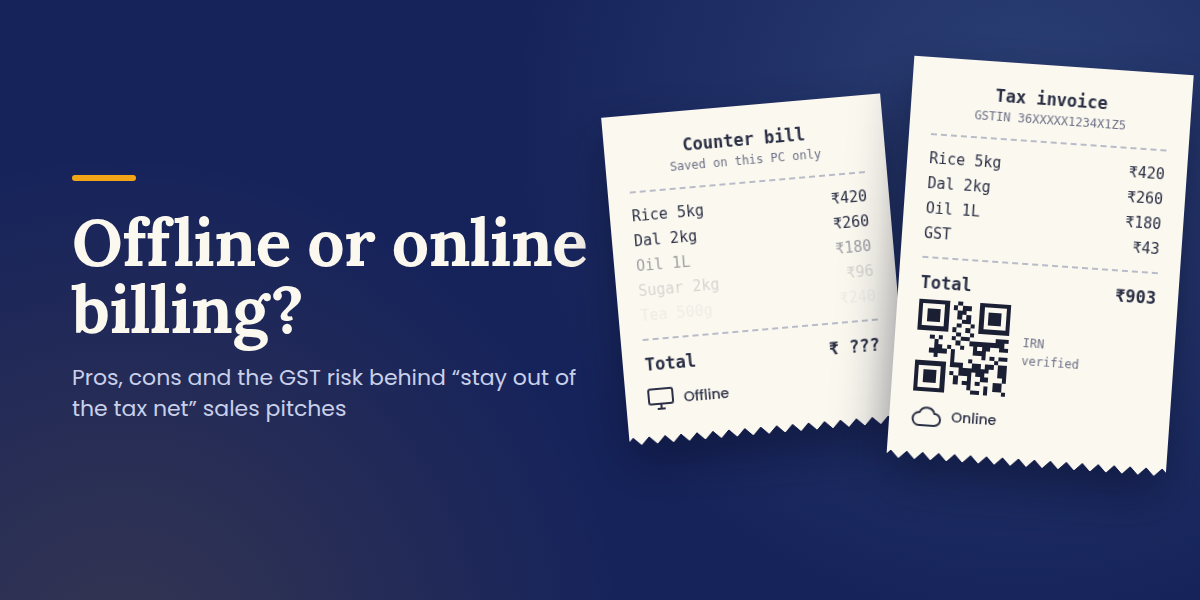
Here's the honest answer. Online systems leave a clear, timestamped, often automatically reported trail. Offline systems don't have to. That gap is what some vendors and dealers exploit in their sales pitch, with hints like "no one can see your data" or "you decide what gets reported."
In practice, this usually means businesses issue some bills that never make it into their books or GST returns, typically cash sales to consumers. Some billing tools have even been caught with features designed to delete or hide transactions after the fact. The appeal is obvious: lower declared turnover means lower GST and income tax, and possibly staying below thresholds that trigger stricter compliance.
It's important to separate the tool from the misuse. Offline software itself is completely legal, and plenty of honest businesses use it for good reasons like poor connectivity or cost. The problem is the specific practice of underreporting sales, which is tax evasion regardless of the software used.
Why the "tax net" pitch is a bad bet
The system is increasingly data-driven. India's tax administration now cross-checks data from many sources: bank deposits, UPI and card transactions, supplier invoices, e-way bills, and your buyers' GST filings. A shop whose declared sales look far lower than its bank inflows or purchases is precisely what automated analytics flag.
E-invoicing keeps expanding. The threshold has fallen in phases from Rs. 500 crore in October 2020 to Rs. 5 crore in August 2023. Once a business crosses Rs. 5 crore in any financial year since 2017–18, e-invoicing applies even if turnover later drops below that level. For covered businesses, B2B invoices that aren't e-invoiced are treated as not issued, and the buyer loses input tax credit, which gives your customers strong reasons to insist on proper invoicing. The GST Council has also proposed a phased rollout of e-invoicing for B2C transactions; for now it applies only to B2B. The direction of travel is clear.
The penalties outweigh the savings. Suppressed sales can lead to tax demands with interest, heavy penalties, and in serious cases prosecution. Records deleted from a local machine can often be recovered forensically during a search, and "the software did it" is not a defence.
It caps your growth. Businesses that keep two sets of books struggle to get bank loans, attract investors, onboard large B2B clients, or sell the business later, because their official numbers don't reflect reality.
So which should you choose?
A practical rule of thumb:
- Choose offline if you have a single small outlet, unreliable internet, a tight budget, and the discipline to take regular backups and file returns accurately.
- Choose online if you have multiple locations, B2B customers, turnover approaching the e-invoicing threshold, or plans to grow and seek financing.
- Consider a hybrid, meaning a cloud system with a solid offline mode that syncs when the connection returns. For many Indian retailers, this is the best of both worlds.
Whatever you pick, be wary of any vendor whose main selling point is secrecy from the tax department. A good billing system should make compliance easier, not help you hide from it. If you're unsure about your obligations, a chartered accountant can tell you exactly which rules apply at your turnover level.
Disclaimer: This post is for general information and isn't legal or tax advice. GST rules change frequently, so check the latest notifications or consult a professional for your specific situation.