
The ₹38,000 a month hiding in your menu card
Most restaurant menus are printed in kitchen order, with a price column down the right. Both cost you money. Here is the fix — plus a free 14-page guide to menu engineering for Indian restaurants.
Your menu is read by every dine-in guest, every service, without exception. It never calls in sick. Forty laminated copies cost ₹8,000–₹15,000 and last four months.
And in most restaurants, nobody has looked at it since the last price revision.
That is a strange thing to leave alone, because a menu does not need more footfall to make more money. It needs the same number of plates sold in a better mix. On a 3,000-cover month at an average bill of ₹620, a modelled redesign that shifts main-course mix by a few percent and lifts dessert attach from 8% to 15% adds around ₹38,000 in gross profit a month. No extra rent. No extra staff. No ad spend.
Here is one change you can make before your next reprint.
Kill the price column
Look at the right-hand edge of your menu. If your prices are stacked in a neat vertical column — especially with dotted lines leading the eye across to them — you have printed a price list, not a menu.
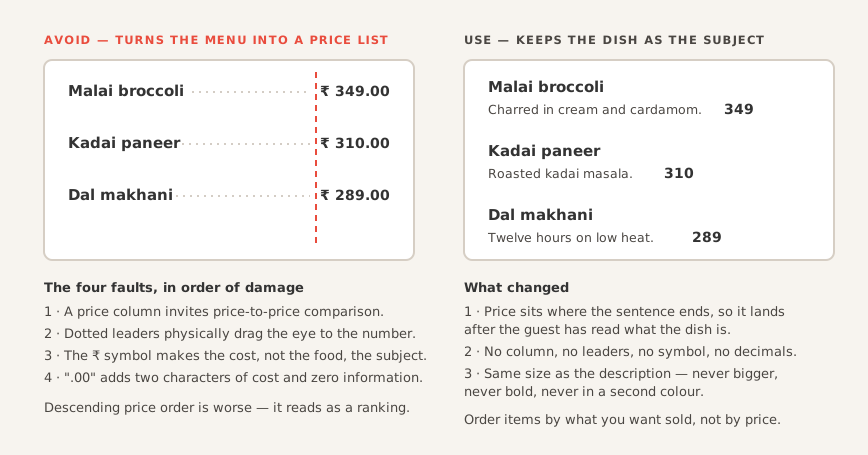
Once prices line up in a column, a guest can compare ₹349 against ₹310 against ₹289 without reading a single dish name. The decision becomes arithmetic. Move each price to sit immediately after its description, wherever that sentence happens to end, and the guest has to read the food before they reach the number.
While you are there: drop the ₹ symbol and the ".00". A 2009 Cornell study run in a working restaurant found that guests given menus with plain numerals spent measurably more than those given menus with a currency symbol or with prices written out in words. The researchers were honest about the size of the effect — it is small, and it was one restaurant over one meal period. But it costs nothing to do.
The golden triangle is a myth
You will have read that the eye lands in the centre of a menu, jumps to the top right, then the top left, and that your money-makers belong in those three spots.
Eye-tracking does not support it. When Cornell researcher Sybil Yang actually tracked how diners scan menus, the dominant pattern was sequential — guests read from the top down, in order, like a page of text.
That is better news than the myth. A triangle is hard to design around. A list is not. It means the order of your categories is the single biggest lever you have, and most Indian menus get it wrong by printing in kitchen order: soups, starters, mains, breads, rice, desserts. That is the order a chef thinks in, not the order a guest buys in.
The full guide
We have put the whole method into a 14-page PDF you can print and work through with your POS reports open beside you. It covers:
- Menu engineering — how to find your Stars, Puzzles, Workhorses and Dogs, and the different instruction each one gets
- The two numbers you need for every item, and why contribution margin in rupees beats food-cost percentage
- Anatomy of an item block — every element annotated, from the veg mark to the calorie line
- Anchoring and decoys — how the first price a guest sees decides what "expensive" means in your restaurant
- Placement — where the first-read and dead zones sit on a single panel, a bifold and a trifold
- Descriptions that sell, and the two kinds of dish you should never describe
- Cutting the menu down — item-count ranges by format, and a five-step method for deciding what goes
- A full before-and-after page, 17 items reduced to 9, with every change marked
- FSSAI and CCPA compliance — calorie declarations, allergens, the current veg/non-veg symbols, and where the service charge position stands after the March 2025 Delhi High Court judgment
- Print specifications that survive a dining room at 8:40pm
- A 14-point checklist to run before anything goes to the printer
Eight annotated diagrams. Worked rupee examples throughout. Written for someone who runs a restaurant and has fifteen minutes.
Free, no form to fill in. All rupee figures in the guide are illustrative models — run them against your own item costs before you act on them.