
Hiring in India's Restaurant Industry
Challenges, Sourcing Channels, Interstate Labour Flows and Training Institutes
India's restaurant labour market is one of the largest hiring problems in the country, and it behaves very differently from white-collar hiring. This note covers four things: why hiring is hard, where employers and candidates actually meet, why certain states depend on workers from other states, and where trained people come from.
1. Why Hiring Is Hard
Demand is outgrowing trained supply
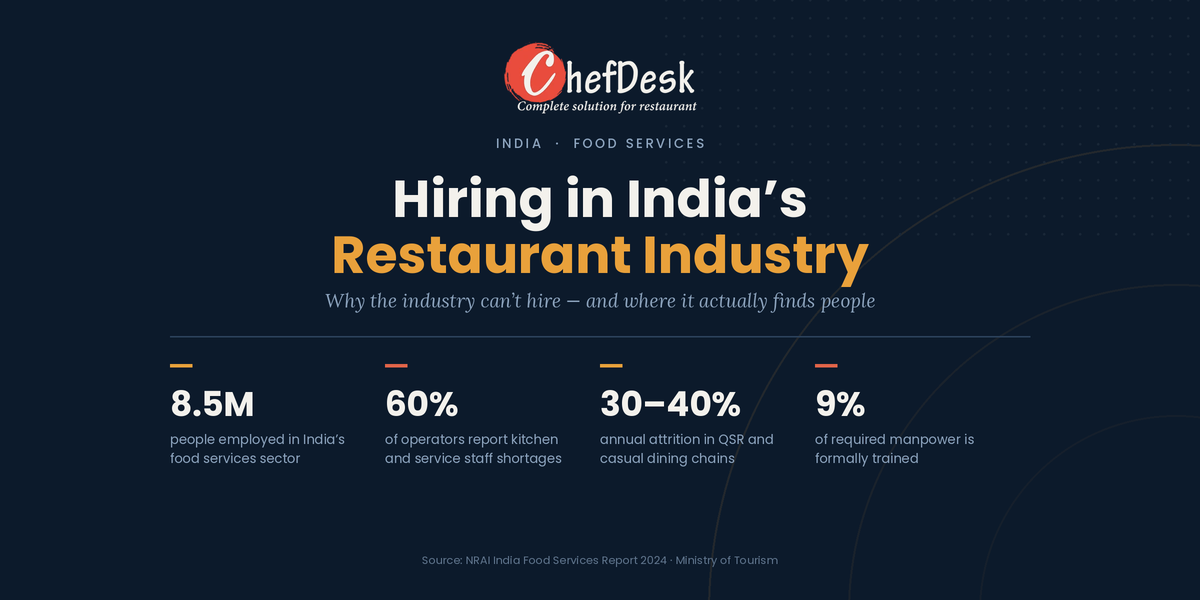
The sector employs roughly 8.5 million people, and NRAI projects more than 10.3 million jobs by 2028. In NRAI's India Food Services Report 2024, close to 60% of operators reported shortages in both kitchen and service staff, driven by migration toward metros and limited local training infrastructure. Attrition is noted as especially high for Tier-I hires posted into smaller cities.
Attrition is the core cost
Annual attrition runs 30–40% in many QSR and casual dining chains (an industry-research estimate rather than an NRAI figure; NRAI's own earlier reporting put it at 20–25%). The combination of high training cost per employee and rapid turnover makes service consistency structurally difficult to hold. At crew level in delivery-heavy QSR formats, the figure is often worse.
A long-standing training gap
A Ministry of Tourism study cited by NRAI estimated formally trained manpower at roughly 9% of total industry requirement. This figure dates to the 2019 report cycle and should be treated as indicative of the scale of the gap rather than as a current measurement. Combined with high attrition, this pushes labour cost up and forces operators into in-house training they are not set up to run.
Other pressures that bite in practice
- Gig competition. Quick commerce dark stores, food delivery and ride-hailing draw from exactly the same labour pool but offer flexible hours, no grooming standards and daily or weekly payouts. A 19-year-old choosing between a commis-3 role at ₹14,000 on a six-day split shift and a delivery job often does not choose the kitchen.
- Job design. Split shifts, 10–12 hour days, no fixed weekly off, and leave denied exactly when workers want it — festivals, harvest, weddings.
- Accommodation. In metros the employer is effectively in the housing business too, and dormitory cost is a material line item.
- Verification. Fabricated experience letters, no verifiable employment history, and police-verification friction for migrant hires.
- Poaching. You train; a competitor two streets away hires at ₹1,500 more.
- Gender skew. Very low female participation in kitchens and late-shift service, driven by safety, transport and facilities.
- Compliance spread. Minimum wages, Shops & Establishments rules, ESI/PF thresholds and contract-labour rules all vary by state, so a multi-state chain runs multiple playbooks.
2. Where Jobs and Employers Actually Meet
The market is layered. The right channel depends entirely on the level of the role being filled.
| Role level | Channel | Notes |
|---|---|---|
| Frontline — stewards, kitchen helpers, commis, dishwashers, cashiers | Apna, WorkIndia, Job Hai (Info Edge/Naukri), QuikrJobs, MyJobee, Vahan | App-first, phone-number based. Built for candidates with no CV. Employers hire over the phone, often within about three days. Apna's hospitality vertical has grown fast in Delhi, Mumbai and Bengaluru. |
| Hospitality-specific | Hozpitality (hozpitality.in), HorecaJobs.in, HotelJobber.com, Hosco | Hozpitality serves the middle-management and skilled service layer. Hosco is the strongest bridge for Indian workers targeting Dubai, Singapore, the Maldives or cruise lines. |
| Supervisory and above — sous chef, exec chef, F&B manager, ops | Naukri, LinkedIn, Indeed, Foundit, Shine | LinkedIn is increasingly where chefs build a visible portfolio and where hidden openings surface. |
| Government / free | NCS (ncs.gov.in), state employment exchanges | Free to post; candidate quality is uneven but coverage in Tier-2 and Tier-3 is real. |
| Bulk / structured staffing | TeamLease, Quess, Betterplace, Awign, Layam | Useful for multi-outlet rollouts and compliance-heavy deployments. |
What actually fills most seats
Be honest about this. Referrals with a cash bonus, WhatsApp and Telegram chef groups, manpower contractors, walk-ins, and IHM / Food Craft Institute placement cells still fill the majority of frontline positions. Portals are best used as top-of-funnel volume and for supervisory hiring; referral chains continue to outperform them at crew level.
3. Why States Hire Across State Lines
This is wage arbitrage plus demographic divergence, hardened over time into self-sustaining networks.
The wage gap is large
The same work pays a multiple more in destination states. As an indication of scale, in Kerala's marine fisheries sector migrant workers earn ₹800–1,200 a day against ₹300–800 for comparable work in Odisha or West Bengal, and remit roughly 75% of earnings home. These are fisheries wages, not restaurant wages — they are cited only to show the size of the interstate gap that drives the same migration into kitchens.
Destination states have thin local supply
Kerala is the extreme case. The Malayalam-speaking native working class has been substantially replaced by non-Keralite workers across metro areas, five-star hotels, restaurants and shops. Kerala employs around 4 million migrant workers, nearly 70% of them from West Bengal and Assam. Migration into Kerala shifted after 2000 from neighbouring Tamil Nadu and Karnataka to West Bengal, Assam, Bihar, Odisha, Jharkhand and the Northeast. Decades of Gulf emigration, high education levels and a high reservation wage mean locals do not take frontline service roles. More broadly, southern states have lower fertility and older workforces, while the Hindi belt and the east have young surplus labour.
Migrants accept what locals will not
Live-in dormitory accommodation, twelve-hour days, no family nearby, and part payment in kind. A local worker goes home at night; a migrant is available at 11 pm on a Saturday.
Chain migration makes it self-reinforcing
One worker brings cousins from the village, so recruitment cost collapses to near zero and regional clusters calcify:
- Odia cooks in Bengali and north Indian kitchens
- Garhwali and Kumaoni cooks across Delhi-NCR
- Udupi and Malayali staff in South Indian restaurants nationally
- Uttar Pradesh and Bihar for tandoor and Mughlai work
- Nepali workers throughout hospitality
The risk this creates
Concentration means whole kitchens empty at once. After the 2026 West Bengal and Assam assembly elections, delayed returns hit Kerala's hospitality, hotel and real estate sectors hardest, and employers across South India resorted to higher wages, free flights and travel support to bring workers back. The assumption that workers leave, vote and return has weakened, and skilled workers now negotiate knowing they cannot be quickly replaced. Rumour and safety scares produce the same effect — Kozhikode has seen restaurants shut when migrant staff left en masse over viral misinformation.
Practical implication: if 80% of a kitchen comes from two districts, that is a concentration risk worth deliberately diversifying.
There have also been state-level attempts at local-employment quotas in private jobs, in Haryana and in a draft Karnataka bill, but these have faced legal challenge and have not held. Worth tracking rather than planning around.
4. Where to Find Trained People
Match the institution tier to the role being filled.
Degree level — management trainees and future managers
The government IHM network under the Ministry of Tourism, entered via NCHM JEE. There are 71 IHMs nationally, though a top handful deliver most of the results. IHM Pusa (Delhi) is the flagship, with IHM Mumbai, Bengaluru, Kolkata (Taratala) and Chennai as the other Tier-A institutes; fees are around ₹85,000 per year. IHM Hyderabad is the relevant option in Telangana.
Top private and corporate academies
WGSHA Manipal is the strongest private institution at roughly ₹4–5 lakh per year with strong Taj, ITC and Hyatt placements. Also IHM Aurangabad, Christ University, GNIHM Kolkata, IIHM and Banarsidas Chandiwala. For the elite management pipeline, OCLD (Oberoi Centre of Learning and Development) and the in-house programmes of IHCL and ITC remain the benchmark.
Culinary and pastry specialists
Culinary Academy of India (Hyderabad), Academy of Pastry & Culinary Arts (Gurugram and Bengaluru), Lavonne Academy (Bengaluru), and IBCA Chandigarh.
Frontline skilling — the tier that matters most to restaurant operators
Degree graduates mostly want hotels, not a 40-cover restaurant. The real pipeline is:
- Food Craft Institutes. State-run, one-year craft courses in food production and F&B service. Also ITIs.
- Hunar Se Rozgar Tak (HSRT). Ministry of Tourism scheme run through IHMs. Courses are free with a stipend of ₹1,500 for F&B Service Steward and ₹2,000 for Multi Cuisine Cook and bakery courses, with a Ministry-recognised certificate on passing.
- HSRT in-house route. Hotels and restaurants can run HSRT training on their own premises by signing an MoU with an IHM and getting trainers and trainees approved, with the trade test conducted at the institute. This is underused: you train your own staff on government funding and get them certified. Confirm current guidelines with the nearest IHM, as the scheme has been amended several times.
- PMKVY and THSC partners. Training partners affiliated to the Tourism & Hospitality Sector Skill Council.
- NGO skilling networks. LabourNet, Don Bosco Tech, Pratham and Yuva Parivartan place first-generation workers.
5. Highest-Leverage Actions
For an operator building a hiring system rather than filling a single vacancy:
- Set up an in-house HSRT tie-up with the local IHM to train and certify staff on government funding.
- Restructure referral bonuses to pay at 3 and 6 months rather than on joining, so the incentive is aligned to retention.
- Source deliberately from two or three unrelated regions so that one festival, harvest or election cannot empty the kitchen.
- Use portals for top-of-funnel volume and supervisory roles; keep referral and contractor channels for crew-level hiring.
- Treat job design — weekly off, shift structure, accommodation quality — as a retention lever, not an overhead.
Appendix A — Sources and References
All links accessed 29 September 2026. A reliability note is given where a figure comes from a secondary, vendor-owned or politically affiliated source rather than a primary one.
A1. Market size and employment
[1] NRAI — India Food Services Report 2024 (association overview page) Supports: 8.5 million people employed; more than 10.3 million jobs projected by 2028; market of ₹5.69 lakh crore growing to ₹7,76,511 crore at 8.1% CAGR by 2028; 1.9% of GDP. https://nrai.org/aboutNewsAndUpdate.aspx?ID=6EQtfBjriLQ%3D&Type=oS9yZygW1hU%3D Primary — the association that publishes the report.
[2] Restaurant India — coverage of NRAI IFSR 2024 Supports: close to 60% of operators facing shortages in both kitchen and service staff; attrition especially high for Tier-I hires posted into smaller cities. https://www.restaurantindia.in/article/india-to-be-the-3rd-largest-food-service-market-by-2028-overtaking-japan-nrai-ifsr-2024 Secondary trade press reporting on a primary report.
[3] Restaurant India — entry-level workforce commentary Supports: food services market ₹5.69 lakh crore in 2024, projected ₹7.76 lakh crore by 2028. https://www.restaurantindia.in/article/why-restaurant-industry-is-bleeding-with-entry-level-workforce.11216
A2. Attrition and the skills gap
[4] IMARC Group — India Food Service Market Supports: annual attrition of 30–40% in many QSR and casual dining chains; chronic shortage of trained chefs, kitchen managers and service staff. https://www.imarcgroup.com/india-food-service-market Commercial market-research page. This figure is vendor-estimated and is not an NRAI number. Treat as indicative.
[5] Indian Retailer / Restaurant India — NRAI report-cycle commentary Supports: Ministry of Tourism estimate that professionally trained manpower is roughly 9% of total requirement; attrition of 20–25%. https://indianretailer.com/restaurant/article/issues-and-challenges-by-restaurant-industry.6121 This is the origin of the widely repeated "9% trained" figure. It dates to the 2019 report cycle, not to IFSR 2024.
[6] NRAI — staffing structure and manpower planning note Supports: rising labour costs, high turnover, attrition high in Delhi, Mumbai and Bengaluru. https://nrai.org/aboutNewsAndUpdate.aspx?ID=ngaagzXFkLs%3D&Type=oS9yZygW1hU%3D
A3. Interstate labour migration
[7] Business Standard — South India labour shortage after the 2026 West Bengal and Assam polls Supports: Kerala employs roughly 4 million migrant labourers, nearly 70% from West Bengal and Assam (CMID data); hospitality, hotels and real estate among the worst affected; employers offering flights, travel support and wage hikes. https://www.business-standard.com/industry/news/south-india-faces-labour-shortage-as-migrants-delay-return-after-polls-126051301235_1.html
[8] Policy Circle — analysis of the same episode Supports: shift in worker bargaining power; thin local reserve supply; restaurants cannot automate kitchens in response. https://www.policycircle.org/opinion/migrant-worker-exodus-keralas/ Opinion/analysis piece.
[9] Peoples Democracy — migrant wages and remittances in Kerala Supports: ₹800–1,200 per day in Kerala against ₹300–800 in Odisha or West Bengal; roughly 75% of earnings remitted home. https://peoplesdemocracy.in/2025/1005_pd/migrants-guests-kerala-experience Two caveats: these are marine fisheries wages, not restaurant wages, and the publication is politically affiliated (CPI(M)). Used here only to indicate the scale of the interstate wage gap.
[10] IJSSHR — Protection Strategies for Interstate Migrant Workers in Kerala Supports: post-2000 shift in source states from Tamil Nadu and Karnataka to West Bengal, Assam, Bihar, Odisha, Jharkhand and the Northeast; concentration of migrant labour in construction, manufacturing, agriculture, hospitality and services. https://ijsshr.in/v7i11/Doc/46.pdf Peer-reviewed journal article.
[11] Gulf News — Kerala's migrant workforce Supports: replacement of the local Malayalam-speaking working class by non-Keralite workers across hotels, restaurants and shops; concentration figures by district. https://gulfnews.com/amp/story/lifestyle%2Fkeralas-migrant-problem-1.1922926
[12] Gulf News — misinformation-driven exodus Supports: Kozhikode restaurant closures after migrant staff left following a false social media campaign. https://gulfnews.com/world/asia/india/fake-news-of-murders-in-kerala-triggers-exodus-of-migrant-workers-1.2102793
A4. Hiring channels and job portals
[13] WorkIndia — frontline hiring behaviour Supports: frontline roles filled in days rather than weeks; direct phone contact outperforms applications. https://blogs.workindia.in/best-job-portals-in-india/ Vendor-owned blog. Performance statistics on this page are marketing claims and are not reproduced in the post.
[14] Investment Guru India — blue-collar recruitment portal round-up Supports: positioning of WorkIndia, Job Hai (Naukri Group), Apna, MyJobee and QuikrJobs. https://investmentguruindia.com/newsdetail/top-6-blue-collar-job-recruitment-portals-to-kickstart-your-career-in-2025408595
[15] SalaryBox — platforms for hiring blue-collar workers in India https://salarybox.in/blog/the-best-platforms-to-hire-blue-collar-workers-in-india/
[16] Platform home pages (for descriptions of scope and positioning) Hosco https://www.hosco.com/en · Hozpitality India https://www.hozpitality.in/ · HorecaJobs.in https://horecajobs.in/ · HotelJobber https://www.hoteljobber.com/ Self-descriptions by the platforms themselves.
A5. Training schemes and institutes
[17] Ministry of Tourism — revised HSRT guidelines Supports: scheme structure, eligible course list, funding basis. https://tourism.gov.in/schemes-and-guidelines/guidelines/revised-guideline-hospitality-training-courses-under-hunar-se Primary — government source.
[18] IHM Ranchi — HSRT programme page Supports: no course fee; stipend of ₹1,500 for F&B Service Steward and Room Attendant and ₹2,000 for Multi Cuisine Cook and Traditional Snack & Bakery; end-of-course test; Ministry of Tourism recognised certificate; batch size 25–30. https://ihmranchi.in/page-hunar-se-rozgar-tak Primary — government institute.
[19] IHM Kovalam — HSRT through hotels Supports: the in-house route — MoU with the institute, trainer and trainee approval, maximum 7 training hours a day, trade test conducted at the institute; NSQF course codes for Multi-Cuisine Cook and F&B Service Steward. https://www.ihmctkovalam.ac.in/hunar-se-rozgar-tak-through-hotels-guidelines-syllabus-other-formats/ Primary — government institute. This is the page to read before approaching an IHM.
[20] Shiksha — top hotel management colleges in India Supports: NCHMCT affiliation and India Today ranking positions. https://www.shiksha.com/hospitality-travel/hotel-hospitality-management/ranking/top-hotel-management-colleges-in-india/98-2-0-0-0
[21] CollegeDekho — hotel management college profiles https://www.collegedekho.com/hospitality-aviation/colleges-in-india/
[22] Education aggregator listings — institute counts and fees Supports: the "71 IHMs" count, IHM Pusa at roughly ₹85,000 per year, and WGSHA at roughly ₹4–5 lakh per year. https://eduvouchers.com/blogs/students-diary/top-colleges-for-hotel-management-in-india · https://gauravtiwari.org/best-hotel-management-colleges-in-india/ Weakest sources in this list — an aggregator and a personal blog. Fee and seat figures change annually and should be checked against the official institute websites and the NCHM JEE information bulletin before publication.
Appendix B — Abbreviations
Industry and market
| Short form | Full form |
|---|---|
| NRAI | National Restaurant Association of India |
| IFSR | India Food Services Report (published by NRAI) |
| QSR | Quick Service Restaurant |
| F&B | Food and Beverage |
| HORECA | Hotels, Restaurants and Catering |
| CAGR | Compound Annual Growth Rate |
| MoU | Memorandum of Understanding |
| MT | Management Trainee |
Government bodies and schemes
| Short form | Full form |
|---|---|
| MoT | Ministry of Tourism, Government of India |
| MSDE | Ministry of Skill Development and Entrepreneurship |
| HSRT | Hunar Se Rozgar Tak — literally "From Skill to Employment", the Ministry of Tourism's short-course hospitality skilling scheme |
| PMKVY | Pradhan Mantri Kaushal Vikas Yojana — the Prime Minister's Skill Development Scheme, MSDE's flagship skilling programme |
| NSDC | National Skill Development Corporation |
| THSC | Tourism and Hospitality Skill Council (the sector skill council for this industry) |
| NSQF | National Skills Qualifications Framework |
| RPL | Recognition of Prior Learning — certifying existing on-the-job skills without fresh training |
| DDU-GKY | Deen Dayal Upadhyaya Grameen Kaushalya Yojana — rural youth placement-linked skilling |
| NCS | National Career Service — the government job portal (ncs.gov.in) |
| ESI | Employees' State Insurance |
| PF / EPF | Provident Fund / Employees' Provident Fund |
| CMID | Centre for Migration and Inclusive Development |
Education and training institutions
| Short form | Full form |
|---|---|
| IHM | Institute of Hotel Management |
| NCHMCT | National Council for Hotel Management and Catering Technology |
| NCHM JEE | NCHM Joint Entrance Examination — the entrance test for IHM admissions |
| FCI | Food Craft Institute — state-run craft-level training institutes |
| ITI | Industrial Training Institute |
| WGSHA | Welcomgroup Graduate School of Hotel Administration, Manipal |
| OCLD | Oberoi Centre of Learning and Development |
| IHCL | Indian Hotels Company Limited (the Taj group) |
| GNIHM | Guru Nanak Institute of Hotel Management, Kolkata |
| IIHM | International Institute of Hotel Management |
| APCA | Academy of Pastry and Culinary Arts |
| IBCA | Institute of Bakery and Culinary Arts |
| CUET | Common University Entrance Test |
Compiled 29 September 2026. Figures are indicative and should be verified against the latest editions of the underlying reports before use in planning or publication.