
The 3 loyalty programs that actually work for bars
A bar is not a restaurant with a liquor licence. The economics are different, the visit pattern is different, and most loyalty advice written for restaurants quietly fails when you apply it behind a bar
A bar is not a restaurant with a liquor licence. The economics are different, the visit pattern is different, and most loyalty advice written for restaurants quietly fails when you apply it behind a bar.
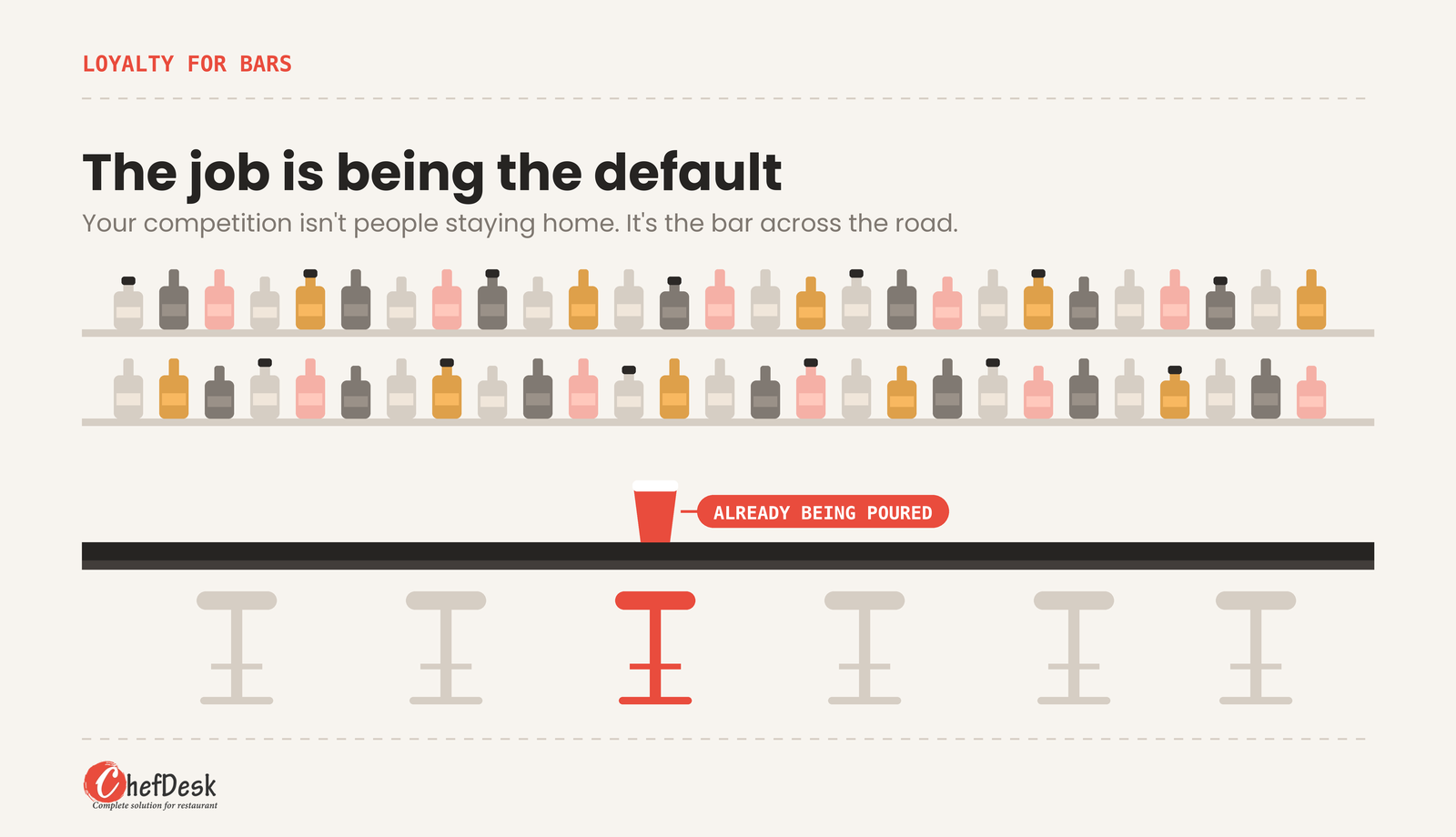
Here's why. Restaurant loyalty is about frequency — get someone from once a month to twice. Bar loyalty is about which bar someone picks on a Friday when four are within walking distance. Your competition isn't people staying home. It's the place across the road.
So the job of a bar loyalty program is narrow and specific: make your bar the default. Below are the three programs that do that, in increasing order of effort.
In India, alcohol is a state subject. Every state's excise department has its own rules on discounting, promotions and what you're allowed to give away. Some states restrict time-limited liquor discounts. Some restrict free pours entirely. Some are relaxed. What's normal in Goa may be a violation in another state.
The safe design principle: build your rewards around food, merchandise, access and experiences rather than free or discounted alcohol. A free plate of wings, a members-only tasting, a branded mug — none of these run into excise rules. "Every 10th drink free" might.
Check with whoever handles your licence before you launch anything. Then read on.
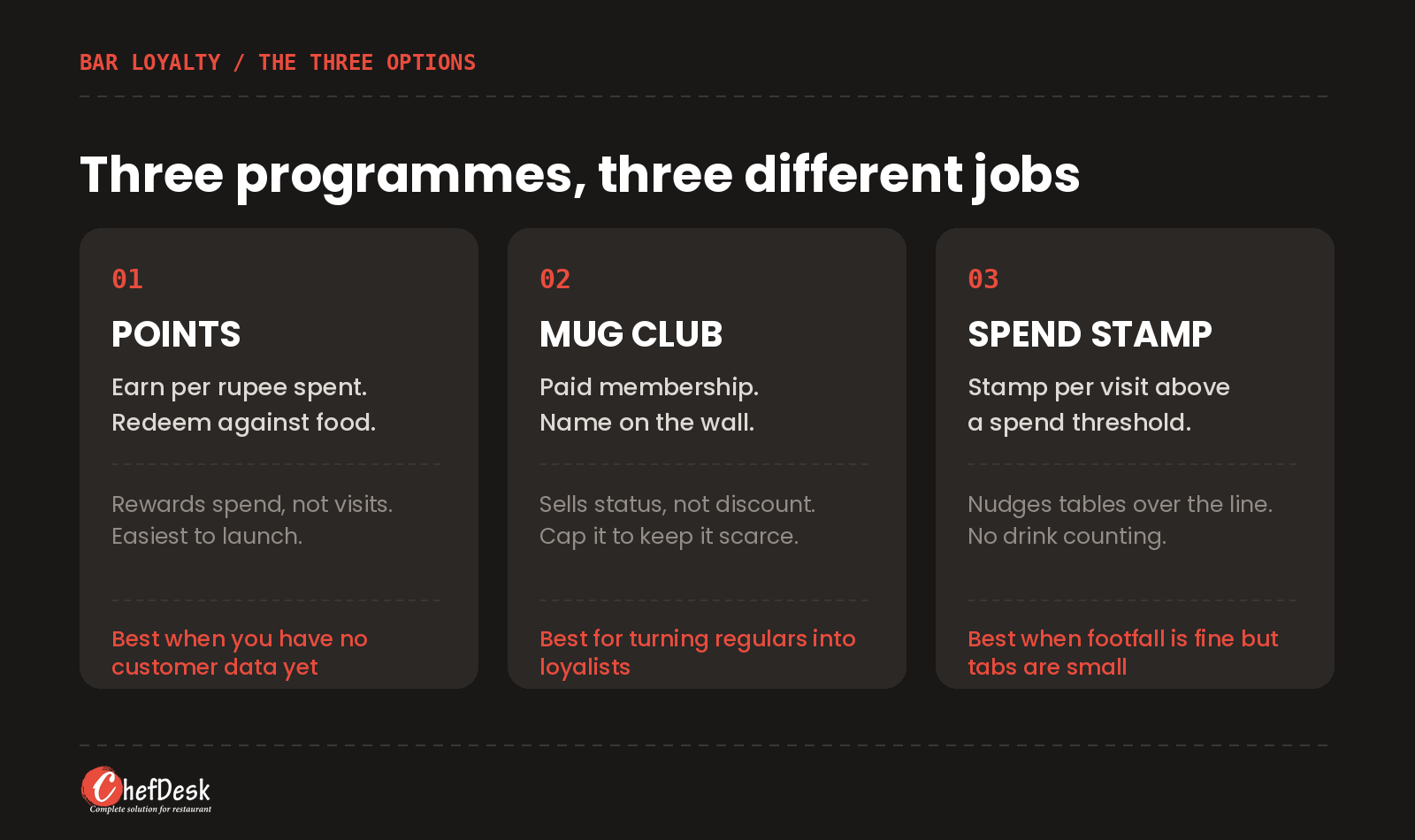
Three programmes, three different jobs. Most bars should start with the first one.
Program 1: Points (the simplest one that works)
What it is: customers earn points for every rupee spent, and redeem them for rewards.
This is the airline model, and it works because everyone already understands it. The Beer Cafe, the Gurgaon-founded pub chain, runs exactly this — a programme called Brew Miles, which is described as being borrowed straight from how airlines built frequent flyer schemes.
How to set it up:
- 1 point per ₹10 spent is easy mental maths
- Reward at a threshold customers can reach in three or four visits, not fifteen
- Redeem against
- food, not liquor — a starter, a dessert, a pizza
- Sign-up is a phone number at billing. Nothing more
Why it works for a bar: it rewards spend, not visits. A group that runs a ₹6,000 tab is worth more than a solo customer with one beer, and points reflect that automatically.
Where it fails: when the reward is too far away. If someone needs ₹15,000 of spending to earn a plate of fries, they'll stop paying attention by visit two. Make the first reward almost too easy. The first redemption is what makes someone a member — everything after that is habit.
Program 2: The mug club (the one that builds regulars)
What it is: customers pay a one-time or annual fee to join a club. In return they get a permanent perk — often a personalised mug kept behind the bar with their name on it.
This is the oldest trick in the pub business and it still outperforms almost everything else. In the US it's a whole category: places like Sunset Beer Co. in Los Angeles charge an annual fee for a custom mug, a standing discount on draught, and early access to new releases.
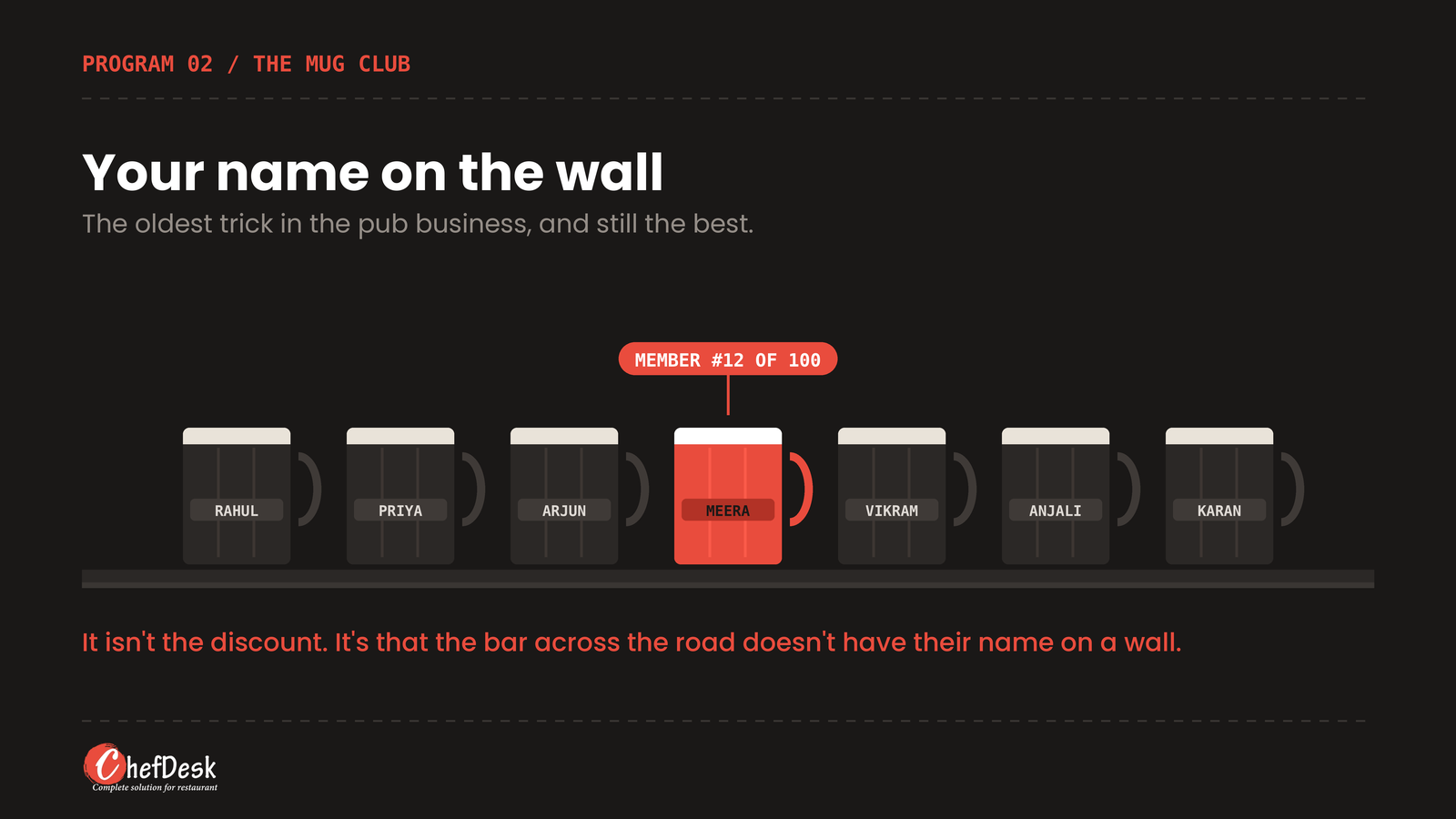

Seven mugs. Seven people who won't be at the bar across the road on Friday.
Why it works so well: it isn't really about the discount. It's about status and belonging. Your mug hanging on the wall says you belong here. People bring friends specifically to show them the mug. A mug club member doesn't compare you to the bar across the road, because the bar across the road doesn't have their name on a wall.
How to set it up:
- Charge a real fee — ₹1,500 to ₹3,000 a year. Free membership signals nothing
- Cap it. "Only 100 members" makes it something to get into
- Give them something physical: a mug, a numbered card, a name on a board
- Add perks that cost you little: first booking on event nights, a reserved table window, early access to a new menu
- Make the staff use their name. That's the whole product
Where it fails: when you sell 400 memberships and nobody feels special. Scarcity is the mechanism. Don't sell it away.
Program 3: The spend-threshold stamp (the one that lifts your average tab)
What it is: a stamp card, but based on minimum spend per visit rather than number of drinks.
Instead of "buy 5 drinks, get the 6th free," it's "spend ₹1,500 in a visit, get a stamp. Five stamps, get a reward."
That one change does two useful things. It stops rewarding the customer who nurses one beer for three hours, and it nudges tables over a threshold — someone at ₹1,300 will often add a starter to reach ₹1,500. It also sidesteps the excise problem, because you're not counting drinks or giving away pours.
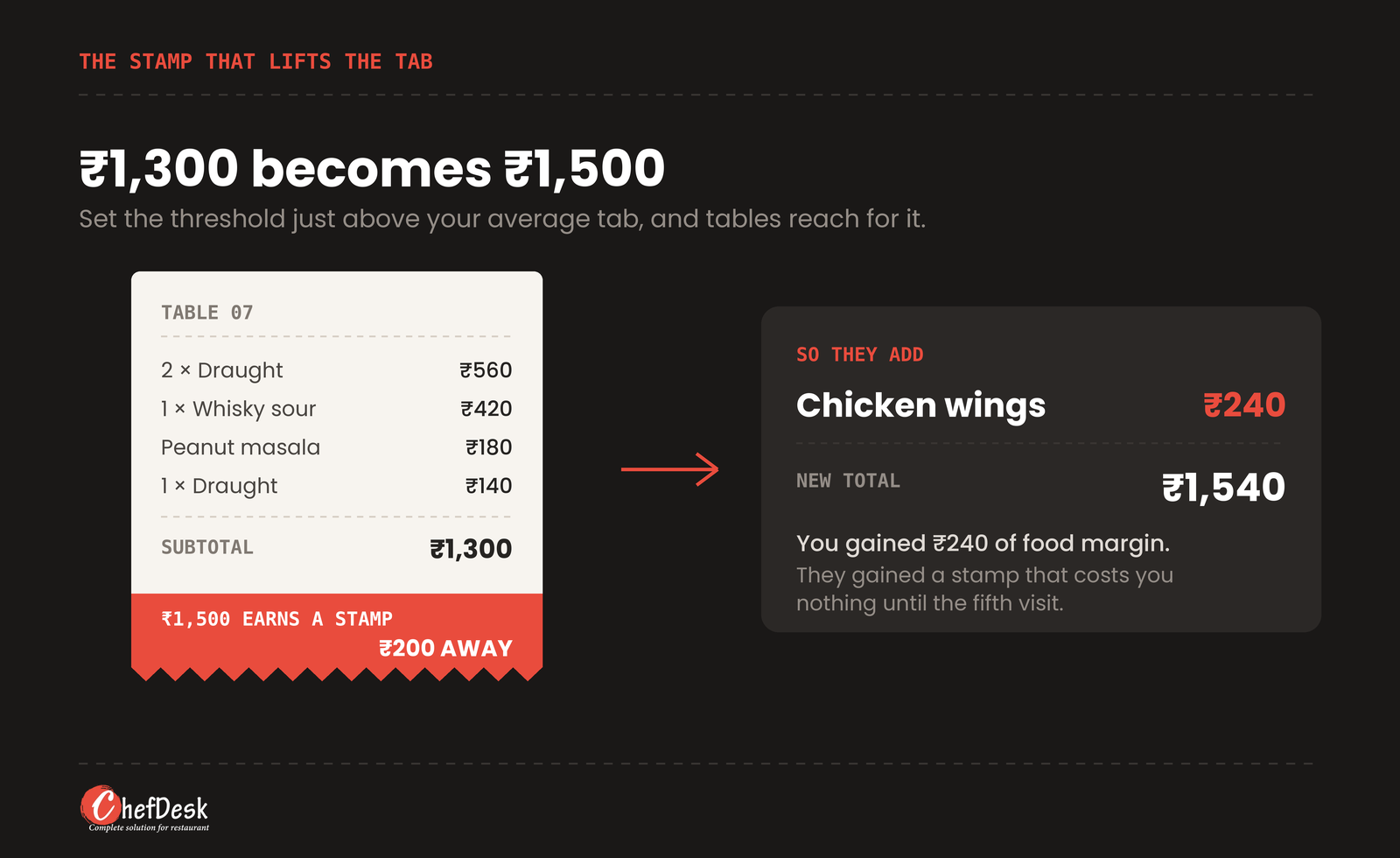
A table at ₹1,300 will reach for ₹1,500. That reach is the whole mechanism.
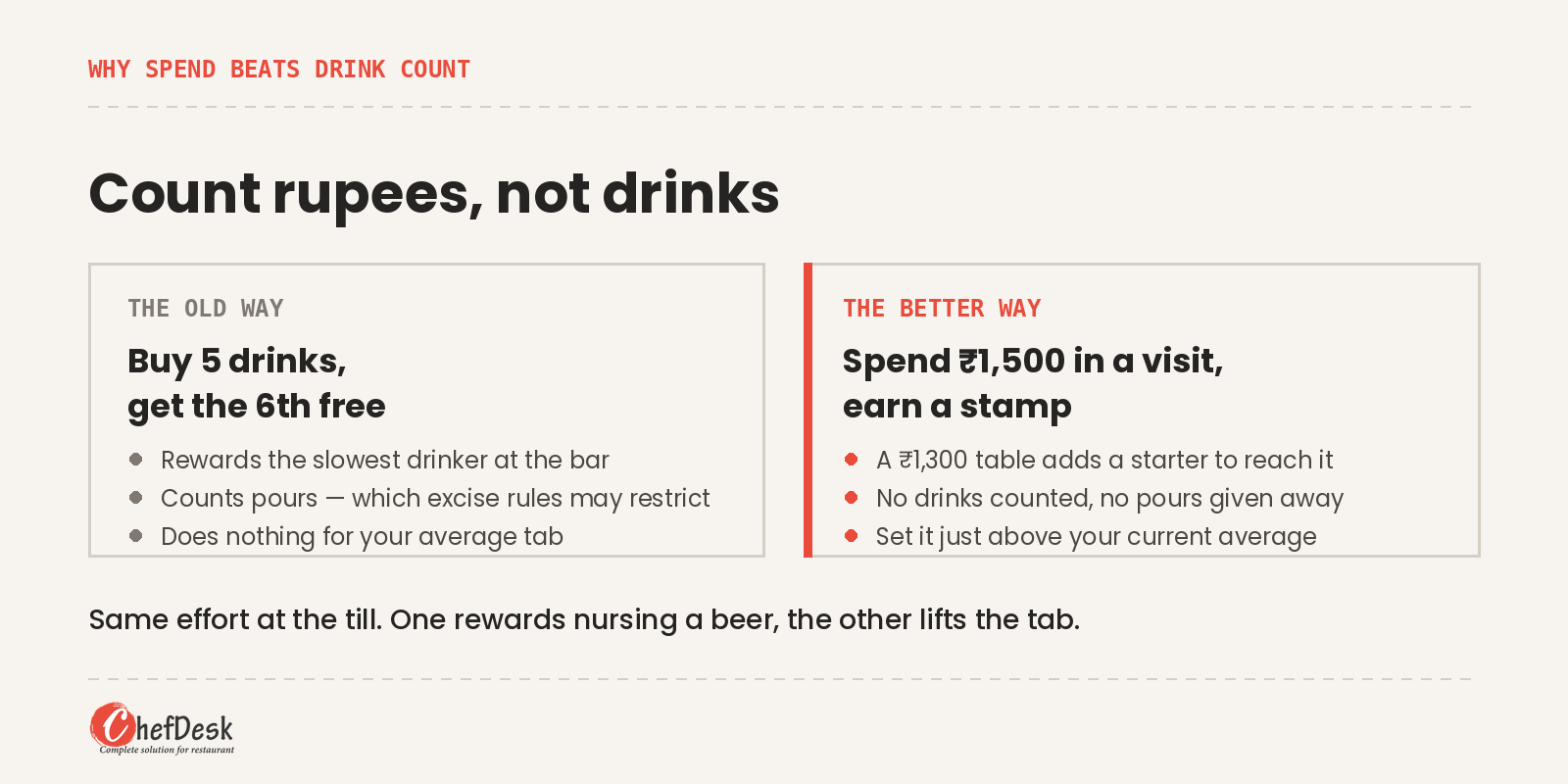
The same effort at the till, with a very different effect on your average tab.
How to set it up:
- Set the threshold slightly above your current average tab. Look at the POS, don't guess
- Reward with food or merch
- Digital, not paper — a paper card in a bar has a short and damp life
- Show progress. "Two more stamps" is a reason to come back this week
Where it fails: if the threshold is set so high it feels like a trap. Slightly above average, not double it.
Which one should you run?
| Your situation | Start with |
|---|---|
| Busy weekends, dead weekdays | Points, weighted toward weekdays |
| Lots of one-time visitors, few regulars | Mug club |
| Decent footfall, low average tab | Spend-threshold stamp |
| No customer data at all | Points — it's the easiest to collect numbers with |
You can run two. Most good bars eventually do — a points programme for everybody, and a small mug club sitting on top of it for the fifty people who are genuinely yours.
Weekday vs weekend: the mistake almost everyone makes
Here is the single most expensive error in bar promotions: running your best offer on your busiest night.
A Saturday discount doesn't bring in people who weren't coming. Saturday was going to be full anyway. All you did was sell your busiest night's inventory at a lower price. You gave money away to people already walking through the door.
The whole point of an offer is to move demand from when you have too much of it to when you have too little.
Think about your week in three buckets:
- Monday to Wednesday — the dead zone. Fixed costs run whether anyone shows up or not. Every additional table here is nearly pure contribution. This is where your incentives belong.
- Thursday — the swing night. Often half-full and easily made full. Good place for something structured: quiz night, a tasting, live music.
- Friday and Saturday — capacity, not demand. Your problem isn't attracting people, it's seating and serving them. Don't discount. Use these nights to enrol people into the programme that brings them back on a Tuesday.
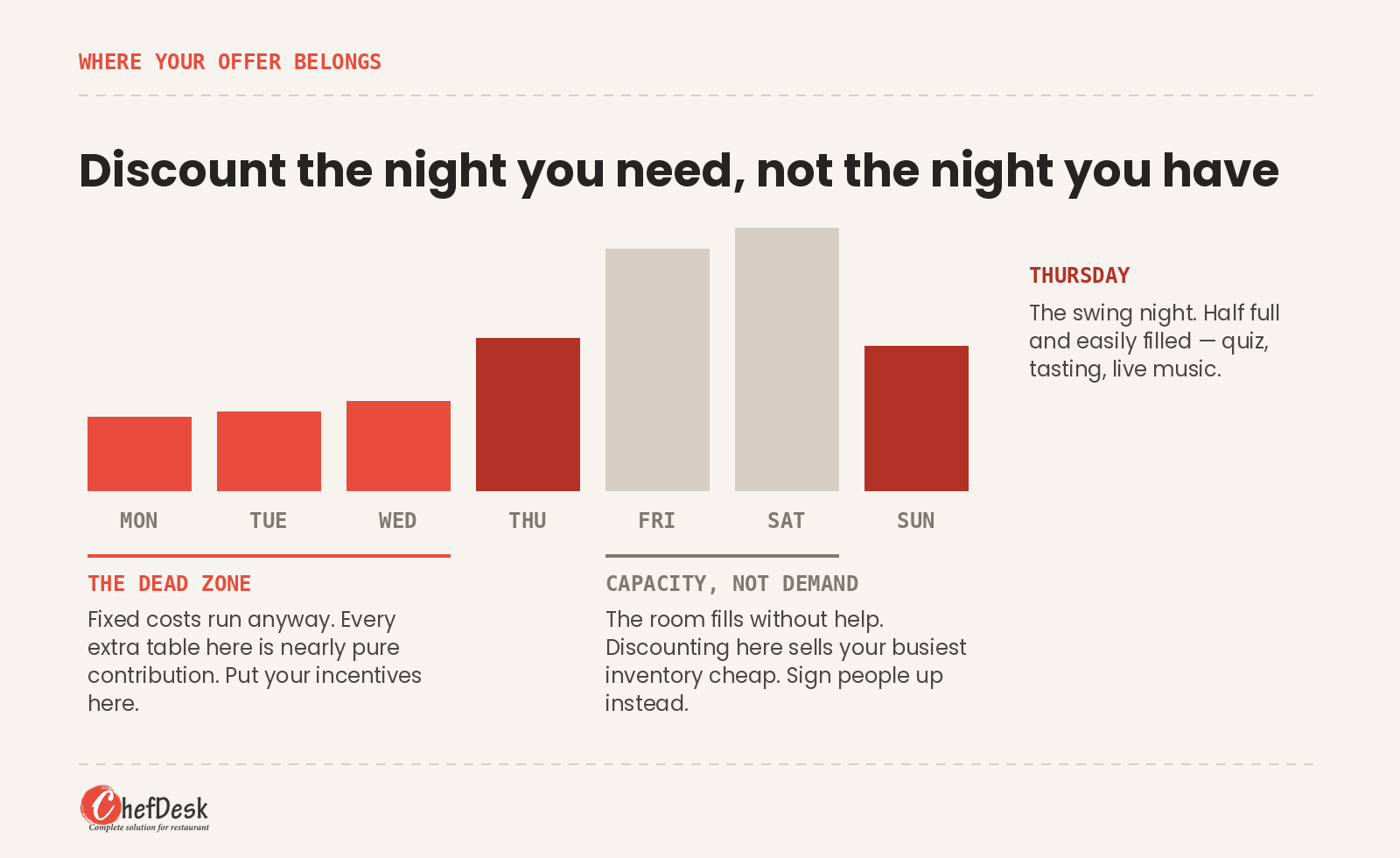
Monday to Wednesday is where an offer earns its keep. Saturday was going to be full anyway.
Practical version: double points Monday to Wednesday. Mug club members get their perk any day, but their guest perk only works Monday to Thursday. Rewards earned on the weekend become redeemable on a weekday. Every mechanism should push the next visit into the quiet part of the week.
And on Saturday, the only thing your staff should be doing is signing people up. A full room is a list-building opportunity, not a discounting one.
Happy hour vs the regular menu
Happy hour and loyalty solve different problems, and confusing them is expensive.
Happy hour attracts strangers. It's a price signal to people who haven't decided where to go. It fills the 5–8pm gap between office and dinner. It's a discovery tool.
Loyalty attracts the same person again. It's not about price at all — it's about recognition.
The two failure modes:
Failure one: happy hour that never converts. Your bar is full at 6pm and empty at 9. People arrive for the price, drink, and leave before the full-price hours start. You've bought footfall and turned it into nothing. The fix isn't ending happy hour — it's using those three hours to enrol people, and building rewards they can only redeem later in the evening.
Failure two: stacking discounts. Happy hour price plus loyalty points plus a member discount, all on the same drink. Now you're paying three times to serve someone who was going to buy that drink anyway. Pick one. The usual rule: members earn points on happy hour spend, but don't get their member discount on already-discounted items.
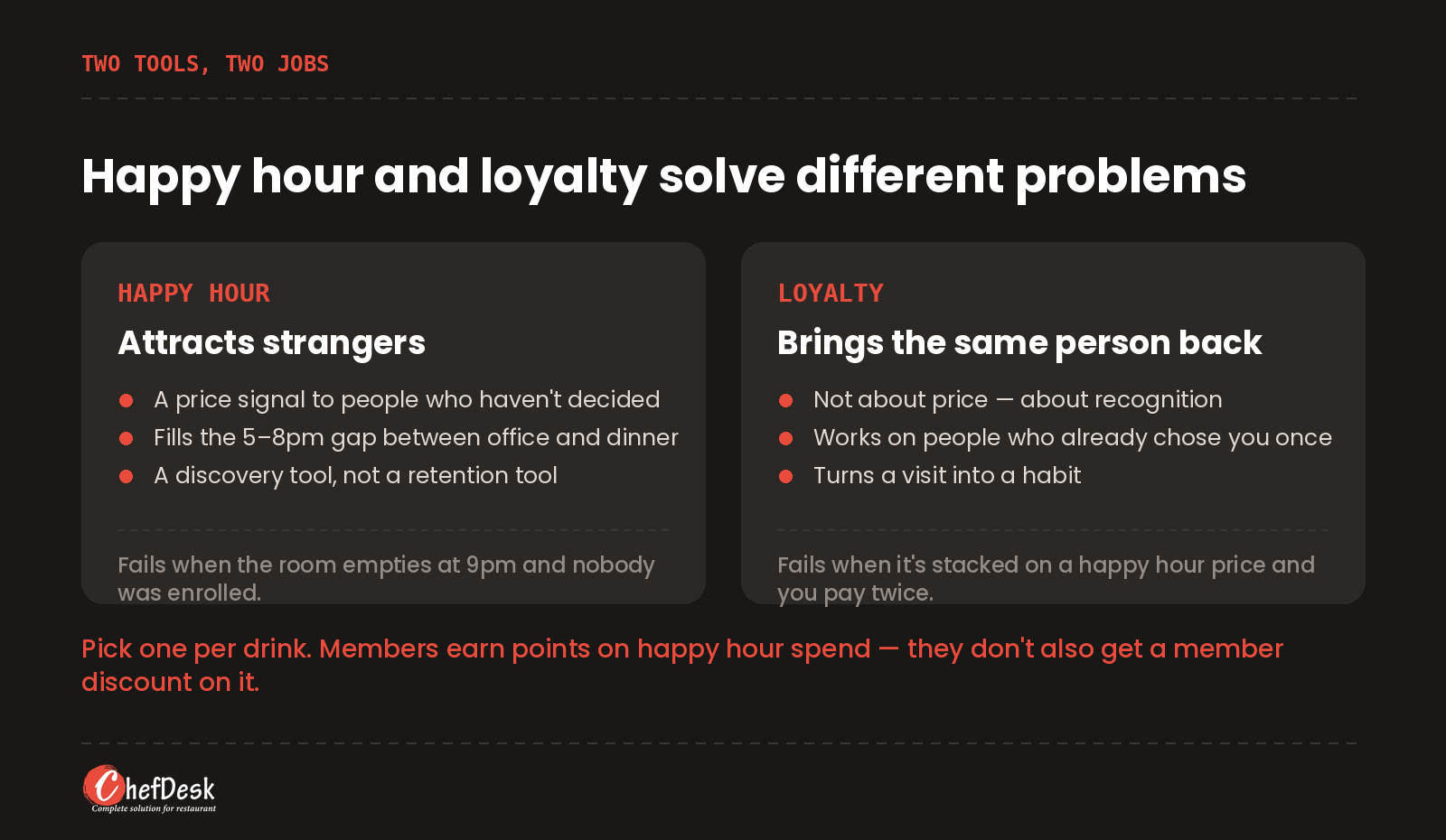
Two tools, two jobs. Problems start when you run both on the same drink.
A cleaner structure, if you want one:
| Time | What's on | Why |
|---|---|---|
| Happy hour | Price offer, open to all. No stacked member discount | Bring strangers in |
| Regular hours | Points earn at full rate; members earn faster | Reward the people who stayed |
| Weekday nights | Double points, member guest perks | Move demand where you need it |
| Weekend | Full price everywhere. Sign-ups only | Don't discount a full room |
One more thing worth saying: check whether time-limited liquor discounting is even permitted where you operate. It's routine in some states and restricted in others, and the rules change with each new excise policy.
Starting on Monday
If you have nothing today, do this in order:
- Collect phone numbers at billing for two weeks. No program yet. Just the number, with permission. You'll learn how many customers you actually have, which is usually a surprise.
- Launch points. One programme, one simple rule, one reward that's easy to reach.
- Weight it toward weekdays. Double points Monday to Wednesday from day one.
- After three months, pick your fifty best customers and offer them a mug club. They'll say yes, because they were already regulars — you're just naming it.
The blunt version
A bar loyalty program isn't a discount scheme. It's a system for being remembered.
The bars that get this right aren't the cheapest on the street. They're the ones where the staff know your name, your drink is already being poured, and there's a mug on the wall with your name on it. The points and the stamps are just the paperwork that makes that possible at scale.
Discount your Tuesday. Never your Saturday. And whatever you build, build it so the reward is a reason to come back rather than a reason to spend less today.
Excise rules on liquor discounting and promotions vary by state in India and change with each excise policy. Verify anything involving free or discounted alcohol with your licensing consultant before launching.
ChefDesk captures customer numbers at billing, runs points and rewards from your POS, and sends the WhatsApp reminders that bring people back on a Tuesday. Start a 30-day free trial →