
UPI MDR Explained: 0.4% Above Rs 2,000 from October 2026
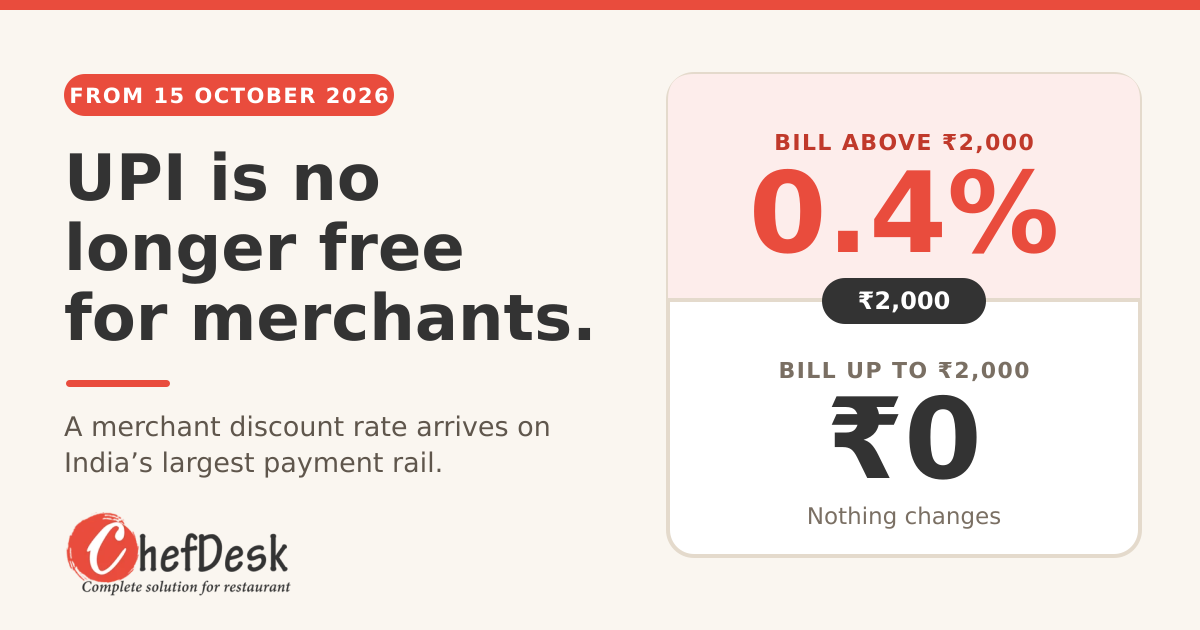
UPI above Rs 2,000 carries 0.4% MDR from 15 October. Merchants will reach for cash first. That trade costs more than the fee they are avoiding.
From 15 October 2026, a Person-to-Merchant UPI transaction above ₹2,000 carries a merchant discount rate of 0.4%, capped at ₹300 per transaction. Below ₹2,000, nothing changes. Person-to-person transfers are untouched. Small merchants under the P2PM framework, receiving up to ₹1 lakh a month through a UPI QR directly into their bank account, continue at zero.
The revenue is split across the chain: issuing banks take 40%, merchant acquirers 30%, UPI apps 20%, and the remainder goes to their bank partners.
That is the whole change. Six and a half years of free digital collection ends for a specific slice of transactions, and the industry is treating it as a regime shift.
We think the first reaction from merchants will be to push customers back to cash, that this reaction will be wrong, and that a meaningful number of merchants will discover they have talked themselves onto a rail that costs four times more than the one they were avoiding.
Here is the argument.
1. Most merchants are not affected at all
Start with the threshold, because the commentary keeps skipping it. MDR applies above ₹2,000.
A tea shop is unaffected. A kirana store is unaffected. A QSR with a ₹280 average ticket is unaffected. An auto driver is unaffected. By transaction count, the overwhelming majority of UPI's P2M volume sits below the line and always has — that is what a payments rail built on ₹40 and ₹300 transactions looks like.
The merchants who feel this are the ones with high-value baskets: jewellers, electronics retailers, furniture showrooms, hospitals and diagnostics, appliance dealers, and the upper end of restaurants. That is a narrow set of merchants, though a meaningful share of rupee value.
So when you read that "merchants will abandon UPI," ask which merchants. The ones loudest about payment costs are often the ones with nothing at stake here.
2. For restaurants specifically, here is the actual number
Run it rather than reacting to it.
| Format | Average bill | MDR per bill | Roughly, per year |
|---|---|---|---|
| Café / QSR | ₹320 | ₹0 | ₹0 |
| Casual dining | ₹1,400 | ₹0 | ₹0 |
| Casual dining, larger groups | ₹2,600 | ₹10.40 | ~₹25,000 on 60 such bills a day |
| Fine dining | ₹4,500 | ₹18 | ~₹33,000 on 50 such bills a day |
| Banquet booking | ₹2,00,000 | ₹300 (capped) | 0.15% effective |
Two things fall out of this. First, if your average cover is under ₹2,000, this news is not about you. Second, the ₹300 cap means the percentage falls as the ticket rises — a two lakh rupee banquet payment costs 0.15%, not 0.4%. The cap is the most merchant-friendly part of the framework and it is getting almost no attention.
For a fine-dining room, we are talking about roughly the cost of one part-time shift a month. Real, but not existential.
3. The cash reflex, and why it is a bad trade
The predictable first move is a sign near the till: large bills, cash preferred. Some merchants will make it politely. Some will make it by claiming the QR is down.
It feels rational. It is not, and the reason is that cash has never been free — it has only ever been unbilled.
Cash costs you counting time at open and close. It costs you denomination management and change shortages. It costs you till discrepancies, which in a business with staff turnover is a polite word for shrinkage. It costs you trips to the bank, and cash deposit charges once you cross your account's free limit. It costs you reconciliation labour at month end. And it costs you the reporting cleanliness that you spent the last five years building.
Add those up honestly and cash handling in retail runs well north of 1% of the amount handled. You are declining a 0.4% charge in order to accept a 1%-plus one, and the 1% is paid in your manager's evenings rather than in a line item, which is exactly why it feels cheaper.
The merchants who will make this mistake most confidently are the ones who have never measured what their cash actually costs. That is most of them, which is why we expect the reflex to be widespread even though it is wrong.
4. You cannot really refuse UPI anyway
There is a structural point here that gets missed because people reason about UPI as though it works like a card terminal.
A merchant controls whether he buys an EDC machine. He does not, in any practical sense, control whether a customer pays by UPI. The QR has been on the counter for six years. The customer has already opened the app. Refusing at that moment means an argument at the till, in front of a queue, conducted by whichever staff member least wants to have it.
That friction is enormous and it is borne entirely by the merchant. Which is why we think the cash push will be loud, short, and mostly rhetorical. It will show up in WhatsApp groups and trade association statements more than it shows up at the counter.
If surcharging is prohibited — as it has historically been for cards — then the merchant's only real levers are refusal or absorption, and refusal is expensive in a way that 0.4% is not.
5. The card detour is the real trap
Here is the part of the chain worth thinking about carefully.
Suppose the cash push works, at least for large tickets. The customer at a ₹28,000 electronics counter is told cash is preferred. She does not have ₹28,000 in cash. Nobody does. So she reaches for a card.
Which card? Not a debit card. At that ticket size she reaches for a credit card, because of the rewards, the interest-free period, and possibly the EMI option the store itself is advertising two feet away.
Debit card MDR is regulatory capped. Credit card MDR is not, and it has never been close to 0.4%.
So the merchant who steered away from a 0.4% charge has landed on a charge several times larger, on exactly the high-value transactions where it hurts most. He has not avoided a cost. He has swapped a small one for a big one and congratulated himself on the way.
This is the single most important thing for a merchant to understand before he puts up that sign. The alternative to UPI at high ticket sizes is not cash. It is credit cards.
(One caveat we are still checking: if RuPay debit remains outside the MDR framework, there is a genuinely free digital rail available at any ticket size. That would change the picture — but it would change it in favour of digital payments generally, not in favour of cash.)
6. Why the endpoint is more UPI, not less
Three reasons we think this settles quickly.
Habit is the strongest force in payments. UPI won because it is faster than the alternatives, not because it was free to the merchant. The customer never knew about MDR and never will. Nothing about the customer's experience changes on 15 October, so nothing about the customer's behaviour changes either.
There is precedent. UPI carried MDR before January 2020. It grew anyway. Card networks have charged MDR for decades without card usage collapsing. No payment method in history has been killed by a merchant fee of 0.4%.
And — the part that is genuinely good news — the acquiring side finally has a business model. Zero MDR did something quietly destructive for six years: it removed any commercial reason for a bank or a fintech to acquire merchants, service them, resolve their disputes, or fight fraud on their behalf. Everyone wanted the consumer side, nobody wanted the merchant side, because the merchant side earned nothing.
With 30% of MDR flowing to acquirers and 20% to apps, that changes. Expect more merchant acquisition, better dispute handling, and real investment in merchant-facing tooling. Merchants complaining about paying 0.4% in October may find in 2028 that it bought them a support number that answers.
7. The thing nobody is talking about: the P2PM cliff
Small merchants receiving up to ₹1 lakh a month via UPI QR directly into their bank account stay at zero MDR.
Any threshold with a cliff at the end of it gets gamed. A merchant at ₹1.4 lakh a month has an obvious, easy, and entirely predictable response: two QR codes, two VPAs, collections split across the proprietor's account and the firm's account.
We are not recommending this. Whether it is permissible depends on how the limit is defined — per VPA, per account, or per PAN — and getting that wrong has consequences well beyond payments. But it will happen at scale, and anyone modelling the revenue from this framework should assume a chunk of the sub-threshold population quietly stays sub-threshold.
8. What a restaurant should actually do
Work out your exposure before you form an opinion. Pull last month's bills, count the ones above ₹2,000, multiply by 0.4% of their value. Most operators will find a number smaller than they feared.
Do not put up a cash-preferred sign. It costs you goodwill at the most sensitive moment of the meal, it will not change customer behaviour much, and at high ticket sizes it pushes guests toward credit cards, which cost you more.
If you are going to steer anything, steer large parties to UPI, not away from it. A ₹40,000 party bill costs you ₹160 on UPI and materially more on a credit card.
Cost your cash properly, once. Take one month: counting time, bank trips, deposit charges, till variances. Put a number on it. You will almost certainly never think about 0.4% the same way again.
Get your reconciliation clean either way. Whatever mix of tenders you end up with, the answer to payment costs is knowing exactly what you collected and through which rail. A merchant who can see that is in a position to negotiate. A merchant matching screenshots at midnight is not.
9. Where we might be wrong
Two honest possibilities.
The cash push could be stickier than we expect in categories where cash was never fully displaced — parts of wholesale, construction materials, some of the jewellery trade — and where the customer's own preference for cash runs in the same direction as the merchant's. In those pockets, 0.4% may be the excuse rather than the cause, and the reversal could be real and durable.
And thresholds have a way of moving. ₹2,000 today can become ₹500 in two years, and 0.4% can become 0.6%. The current framework is mild. The precedent it sets — that UPI is a chargeable rail — is the thing that actually matters, and merchants reacting strongly to a small number may be reacting correctly to a large principle. We think they will still end up on UPI. We are less sure they are wrong to be annoyed.
Published [DATE]. The MDR framework takes effect 15 October 2026 and the details above are drawn from NPCI's published FAQ. We will update this post once merchant behaviour after the transition is actually observable rather than predictable.