
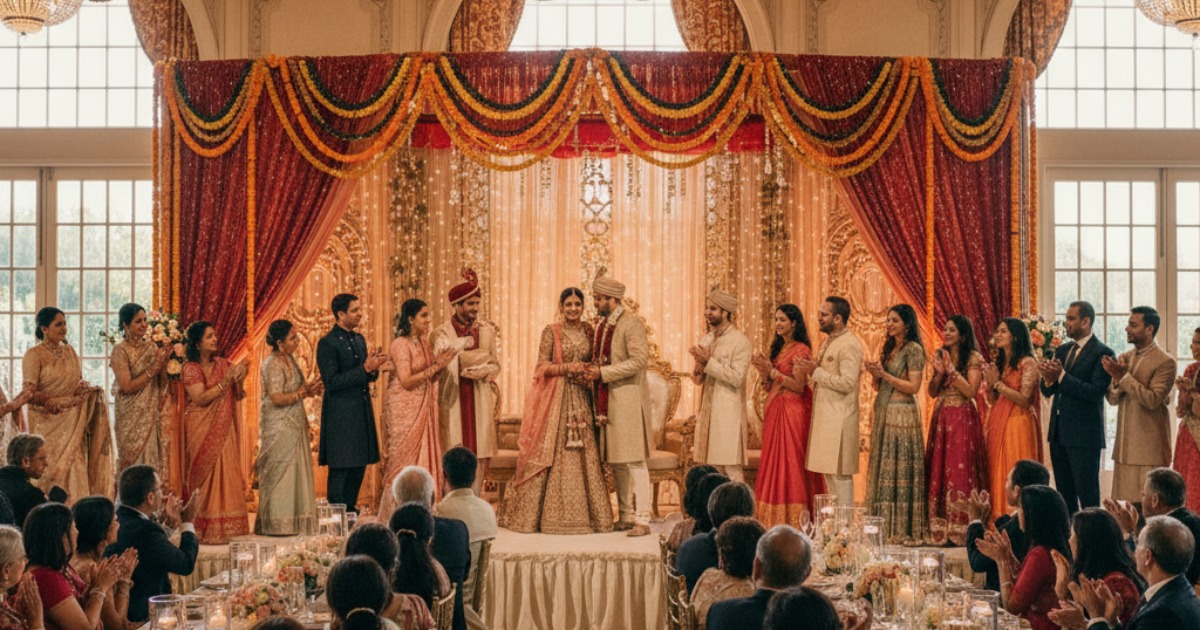
Banquet Management Software: Why Restaurants Need It, and How the Options Compare
A table of four on a Tuesday is a guess. A 300-guest reception on 18 November is a contract. Banquet revenue behaves nothing like à la carte — which is why your POS cannot manage it, and what the alternatives actually offer.
In short: Banquet revenue behaves nothing like à la carte revenue. It is booked weeks ahead, negotiated per event, paid in instalments, and involves vendors you do not employ. Most restaurants run it on a diary, a WhatsApp group and a spreadsheet — which is why halls get double-booked and advances go uncollected. The software market splits into five quite different categories, and the right one depends less on features than on whether you are a banquet hall, a restaurant with a party room, or a hotel.
The revenue is better behaved than your dining room
A table of four on a Tuesday is a guess. A 300-guest reception on 18 November is a contract.
Everything that makes restaurant revenue stressful is absent from banquet revenue. The guest count is confirmed in advance, so you buy to the number and waste collapses. The money arrives partly before the event rather than entirely after it. The date is locked, so you can roster against it. And the ticket size is an order of magnitude larger than a dinner cover.
The demand side is not small either. India sees roughly ten million weddings a year, against a wedding industry estimated at around USD 130 billion. Wedding catering alone is put at roughly USD 16 billion, growing at about 12% a year. Those are commercial research estimates rather than measured figures, but the direction is not in doubt.
You probably already have the asset
This is the part owners overlook. If your restaurant has a private dining room, a first-floor section that can be closed off, a rooftop, or a hall you occasionally give over to birthday parties — you are already in the banquet business. You are simply running it as an exception rather than as a product.
That matters because the marginal economics are unusually good. The kitchen exists. The staff exist. The rent is paid. An event that fills a room you would otherwise half-sell on a Wednesday is close to pure contribution.
But it is operationally a different business
Here is where it goes wrong.
À la carte service is a transaction: order, serve, bill, done, forty minutes. A banquet booking is a project that runs for weeks:
Enquiry → availability check → site visit → menu discussion → estimate → negotiation → revised estimate → contract → advance → menu finalisation → guest count confirmation → vendor coordination → event setup → service → balance payment → vendor settlement → review
Seventeen steps, several people, and multiple points at which money moves. Your POS was not built for any of it, because none of it happens at a table.
What actually breaks
The failure modes are consistent enough to list.
Double bookings. Two staff, one diary, two enquiries for the same Saturday. The one you discover late is the one you have to refund and apologise for.
Quote inconsistency. Your manager quotes ₹1,100 per plate. Your partner quotes ₹950 to a similar enquiry the same week. Both customers eventually find out.
Lost enquiries. A call comes in while service is running. Someone writes the number on a bill pad. Nobody calls back. In a business where one booking is worth two or three lakh, an enquiry lost to a notebook costs you in a way a lost table never does.
Uncollected balances. The advance came in. The event happened. The balance now sits somewhere between the customer's intentions and nobody's follow-up list.
Untracked vendor payments. Décor, sound, photography, extra staff. You owe four vendors against one event, and the amounts live in a chat thread.
No record of what was promised. Three months after a verbal agreement, the customer remembers the package differently than you do. Without a signed estimate, they are probably going to win that argument.
None of these are exotic. They are the ordinary consequence of running a project-based business with transaction-based tools.
What banquet software actually has to do
Before comparing products, it helps to know the capability set. A real banquet system covers six areas.
Enquiry pipeline. Capture from calls, walk-ins and the website, then track each lead from first contact to confirmed or lost. This is a CRM function, and it is the one most restaurants have nothing for.
Availability and calendar. Multiple halls, multiple time slots, visible to everyone, with holds and a waitlist. The highest-value function in the list, because its failure is the one your customers see.
Quoting and contracting. Itemised estimates covering hall rent, per-plate catering, décor and services; revision history; conversion into a GST invoice; and a contract the customer can sign without visiting.
Payments. Advances, balances, reminders, and a clear view of what is owed across every upcoming event.
Event execution. Menu and package definition, inventory allocation for chairs, linen and crockery, floor plans and seating, vendor coordination and vendor payables.
Multi-property and roles. If you have more than one hall or venue, staff access scoped per property.
A tool that does three of these well and ignores the rest will leave you running a second system alongside it — usually the spreadsheet you were trying to escape.
The market splits into five categories
This is the useful framing. Products that look comparable on a feature list are built for genuinely different buyers.
1. Global venue CRM platforms
Tripleseat, Event Temple, Perfect Venue, Cvent, iVvy, Planning Pod
Mature, well-funded products built around BEOs (banquet event orders), lead management and event sales pipelines. Strong on the sales side, often integrated with hotel property management systems.
Indicative pricing: Perfect Venue publishes $99/$199/$299 per location per month. Event Temple starts around $249/month. Tripleseat and Cvent are quote-based.
The India problem. They are priced in dollars, built around US sales workflows, and GST handling, Indian payment methods and per-plate catering structures are not native concerns. For a hall doing ₹8 lakh a month, a $249 subscription is a material line item in a way it is not for a US hotel.
2. Catering-first platforms
Caterease, Flex Catering, Total Party Planner, Curate
Built for caterers rather than venues, so the strength is menu costing, prep sheets and production planning. Total Party Planner publishes $119/month; most others are quote-based.
A better fit for an off-premise catering business than for a hall, and weaker on venue availability and multi-hall calendars.
3. Hotel PMS with a banquet module
IDS Next, eZee, Kubicale, Hotelogix, Djubo, Aiosell, WINCLOUD, Hotelx
Established Indian hospitality vendors with banquet as one module among rooms, housekeeping, channel manager and POS. IDS Next in particular has deep banquet capability and serves large Indian hotel groups.
Indian PMS pricing commonly runs ₹2,000–₹15,000 per month depending on scale, with enterprise deployments quoted separately.
The catch for restaurants. These are room-centric products. You are buying a hotel system to use one module, and most of what you pay for assumes an inventory of bedrooms you do not have. Worth noting that at least one Indian industry guide lists the banquet module among features small properties are sold and do not need — which tells you how it is positioned within that stack.
4. India-built banquet specialists
Banqetly, BookEventz Venue Manager, VenueLook, Mangari, MMI, Evision, Booking Master
Built for Indian banquet halls, with GST billing, local support, and in some cases marketplace lead generation attached — BookEventz and VenueLook both began as venue listing platforms.
Pricing is mostly unpublished. Techjockey lists Booking Master at around ₹10,450 per month and puts entry pricing for the category at roughly ₹8,378 per month, though these figures should be verified directly with the vendor.
5. Restaurant platforms with banquet built in
ChefDesk
The newest position, and the one with the narrowest but clearest fit: a restaurant management system where banquet sits alongside POS, kitchen display, table reservation and catering quoting, on the same customer record and the same billing stack.
Pricing: included at no extra cost for existing ChefDesk users. For venues using the banquet module on its own, ₹15,000 per year per venue, where a venue is a single hall. Multi-venue properties are quoted on request.
(Disclosure: ChefDesk is our product.)
The comparison
| Global venue CRM | Catering-first | Hotel PMS module | India banquet specialist | Restaurant platform | |
|---|---|---|---|---|---|
| Examples | Tripleseat, Event Temple, Perfect Venue, Cvent | Caterease, Flex, Total Party Planner | IDS Next, eZee, Hotelogix, Djubo | Banqetly, BookEventz, Booking Master | ChefDesk |
| Built for | Hotels, large venues, US market | Off-premise caterers | Hotels with rooms | Standalone banquet halls | Restaurants that also do events |
| Enquiry pipeline | Strong | Moderate | Moderate | Strong | Yes |
| Multi-hall calendar | Strong | Weak | Strong | Strong | Yes |
| Per-plate catering packages | Weak for India | Strong | Moderate | Strong | Yes |
| GST invoicing | No | No | Yes | Yes | Yes |
| Vendor payables | Varies | Weak | Varies | Varies | Yes |
| Shares a kitchen with your restaurant | No | No | Partly | No | Yes |
| Typical pricing | $99–$299+/mo | $119/mo+ | ₹2,000–₹15,000/mo | ~₹8,000–₹10,500/mo | ₹15,000/yr per venue; free for existing users |
| Publishes pricing? | Partly | Partly | Rarely | Rarely | Yes |
Feature assessments are category-level generalisations drawn from vendor materials and review sites, not hands-on testing. Individual products vary. Verify against a demo.
How to choose
If you are a standalone banquet hall with no restaurant, an India specialist or a global platform will both work. Decide on support and GST handling rather than features — the feature lists converge, and local support does not.
If you are a hotel with banquet halls, your PMS vendor's module is usually the right answer despite its limitations, because integration with room bookings and a single guest folio matters more than best-of-breed banquet features.
If you are a restaurant with a party room, a rooftop or a hall, the question is different. You are not trying to run a venue business. You are trying to stop losing enquiries and double-booking a Saturday. The decisive factor is whether banquet connects to the kitchen and the billing you already run, because the alternative is a second system, a second login, and a second set of numbers that never reconcile.
A note on how these are priced
The pricing models differ as much as the products, and they are worth comparing on the same basis before the numbers mean anything.
| Model | How you are charged | What drives the bill up |
|---|---|---|
| Per location, per month | Global platforms, typically $99–$299 | Adding venues |
| Per event room, per month | Pxier-style, with a monthly minimum | Adding halls |
| Per user, per month | Some CRMs | Adding staff logins |
| Per month, flat | Most Indian specialists | Plan tier |
| Per venue, per year | ChefDesk, ₹15,000 | Adding venues |
A per-user model punishes you for giving the sales team and the operations team their own logins — which is exactly what stops double bookings. A per-month model is easier to leave than an annual one. Work out your likely annual cost at the number of halls and staff you will have in two years, not today.
Six questions worth asking any vendor
- Is pricing published, and what does it depend on — halls, users, events, or revenue?
- Does contract e-signature work for Indian customers on mobile?
- How does it handle a guest count that changes 48 hours out?
- Can it track what I owe vendors, or only what customers owe me?
- What happens to my data if I leave?
- Can I see a live demo with my own hall and menu, not a sample account?
The short version
Banquet revenue is the best-behaved money a restaurant can earn — committed ahead, paid partly in advance, with a known headcount. Most restaurants manage it with tools designed for the opposite kind of revenue, and lose bookings, margin and advances in the gap.
The market has real options at every size. The question to settle first is not which product is best, but which kind of business you are: a hall, a hotel, or a restaurant that also hosts events. The answer determines the category, and the category narrows the list far more usefully than any feature comparison will.
Sources
Links accessed 11 October 2026.
Market context
- MarkNtel Advisors — India wedding catering market and the USD 130 billion Indian wedding industry estimate. https://www.marknteladvisors.com/research-library/wedding-catering-services-market-india.html Commercial market research.
- MarkNtel Advisors — roughly 10 million weddings annually in India. https://www.marknteladvisors.com/research-library/india-catering-market.html
Global and catering platforms
- Guideflow — banquet management software comparison, including Perfect Venue at $99/$199/$299 per location per month, Event Temple from $249/month, Total Party Planner at $119/month and Pxier from $65/month. https://www.guideflow.com/blog/banquet-management-software Vendor-published content marketing.
- Pxier — published pricing of $10–$20 per event room per month with $75–$150 monthly minimums. https://www.pxier.com/en/event-booking-software Vendor's own pricing page.
- Deelo — comparison of Tripleseat, Event Temple, Planning Pod, Caterease, Curate, EventPro and HoneyBook for banquet halls. https://www.deelo.ai/blog/best-banquet-hall-software-2026 Vendor comparison that includes the vendor.
Indian market
- Techjockey — banquet management category listing; Booking Master at ₹10,450/month; category entry pricing around ₹8,378/month. https://www.techjockey.com/category/banquet-management Directory site operating partly on paid placement.
- Techjockey — Indian banquet software round-up including Pxier, Caterease, MMI and Mangari. https://www.techjockey.com/blog/top-banquet-software-list
- Banqetly — India banquet software comparison. https://banqetly.com/top-banquet-software-in-india-2025/ Published by Banqetly, which it ranks first. Cited as evidence of the market's self-referential content, not as an assessment.
- Next Event App — Banqetly alternatives, including BookEventz Venue Manager's marketplace-plus-management model. https://nexteventapp.com/best-banqetly-alternatives-in-2026/
Indian hotel PMS with banquet modules
- Codingclave — Indian PMS comparison: eZee from around ₹4,500/month, Djubo ₹2,500–₹8,000/month, IDS Next custom enterprise pricing, with banquet and event management noted as an IDS Next strength. https://codingclave.com/blog/best-hotel-management-software-india-2026 Vendor blog; pricing figures differ from its own other article, so treat as indicative only.
- Codingclave — the observation that a conference and banquet module is among features small properties are sold but do not need. https://codingclave.com/blog/hotel-management-software-small-boutique-hotels-india-2026
- App Advisor — confirmation that most Indian hotel software vendors do not publish prices. https://appadvisor.in/blogs/hotel-resort-management-software-india