
WhatsApp Ordering for Indian Restaurants: The Commission-Free Channel Hiding in Plain Sight
Every restaurant in India already has a direct line to its customers. Most use it to send "Order confirmed" and nothing else. Here is the unit economics, the failure patterns and a 30-day playbook.
Every restaurant in India already has a direct line to its customers. Most are using it to send "Order confirmed ✅" and nothing else.
In July 2026, restaurants across Bengaluru told Swiggy and Zomato they would stop accepting orders from August 15 unless commissions, discount participation and advertising deductions were revised. The National Restaurant Association of India has been arguing for years that platform commissions of 25–35%, plus mandatory discounts and ad spends, have made delivery a volume business with no profit at the end of it.
You have probably read that headline. Here is the more useful question: if you had to replace 20% of your aggregator volume tomorrow, where would it come from?
For most Indian restaurants, the honest answer is WhatsApp. Not a new app your customers will never download. Not a website they will visit once. The green icon they already open forty times a day.
Why WhatsApp is the only direct channel with real reach in India
Direct ordering has been the industry's answer to commissions for a decade. It has mostly failed, for one reason: acquisition. Getting a customer to download your app costs more than the commission you were trying to save.
WhatsApp inverts that maths.
- Over 500 million Indians are already on the platform. There is nothing to install, no password to reset, no onboarding funnel to leak customers.
- Message open rates on WhatsApp are close to 100% — an order confirmation, a Sunday brunch offer and a "we miss you" nudge all land in the same thread as messages from the customer's family.
- It is bilingual by default. Your customer types "1 paneer tikka, no onion" in whatever script or Hinglish they think in, and it works.
- Payment is solved. A UPI link inside the chat closes the loop in under ten seconds.
The channel is not new. What has changed is that the tooling around it — the WhatsApp Business API, catalogue messages, automated flows — is now cheap enough that a 15-table café can run it, not just a 200-outlet chain. The three ways customers can order on WhatsApp are broken down in the pillar guide.
The unit economics, on one order
Take a ₹600 order.
Through an aggregator
| Line item | Amount |
|---|---|
| Order value | ₹600 |
| Platform commission (~25%) | –₹150 |
| Discount contribution (your share of the "50% OFF") | –₹100 |
| Payment gateway + charges | –₹15 |
| Net realisation | ~₹335 |
Through WhatsApp
| Line item | Amount |
|---|---|
| Order value | ₹600 |
| Commission | ₹0 |
| Delivery cost (own rider or third-party logistics) | –₹40 |
| UPI charges | ₹0 |
| Messaging cost (API conversation) | ~₹1 |
| Net realisation | ~₹559 |
Run your own numbers — commission slabs and discount participation vary by city and contract — but the shape of the result rarely changes. One WhatsApp order is worth roughly one and a half aggregator orders. Convert a fifth of your delivery volume and you have effectively given yourself a raise without adding a single cover.
And that is before the second, larger benefit: on WhatsApp, the customer is yours. Name, number, order history, preferences, allergy notes. On an aggregator, that data sits behind a wall you pay rent to stand next to.
Where restaurants get WhatsApp ordering wrong
Most operators try this, and most quietly stop within two months. The failure pattern is always the same.
- It runs on a personal phone. One handset at the counter, one manager answering, orders lost when he steps into the kitchen. Nothing scales past twelve orders a day.
- Orders get retyped into the POS. Every order is entered twice — once in the chat, once at the till. Which means wrong items, wrong table, wrong GST treatment, and a cashier who starts discouraging WhatsApp orders because they slow him down.
- The menu goes stale. A PDF sent in January still lists the paneer dish you stopped serving in March, at last year's price.
- Inventory doesn't move. Twenty WhatsApp biryanis leave the kitchen but the stock report only knows about the POS ones. By week's end your consumption variance is fiction.
- Nobody follows up. The order is confirmed and the conversation dies. No feedback ask, no reorder nudge, no reason for the customer to come back to the thread instead of the app.
None of these are WhatsApp problems. They are integration problems. WhatsApp ordering only works when the chat is a front door to your existing operation — not a parallel operation running on a manager's personal number.
How ChefDesk closes the loop
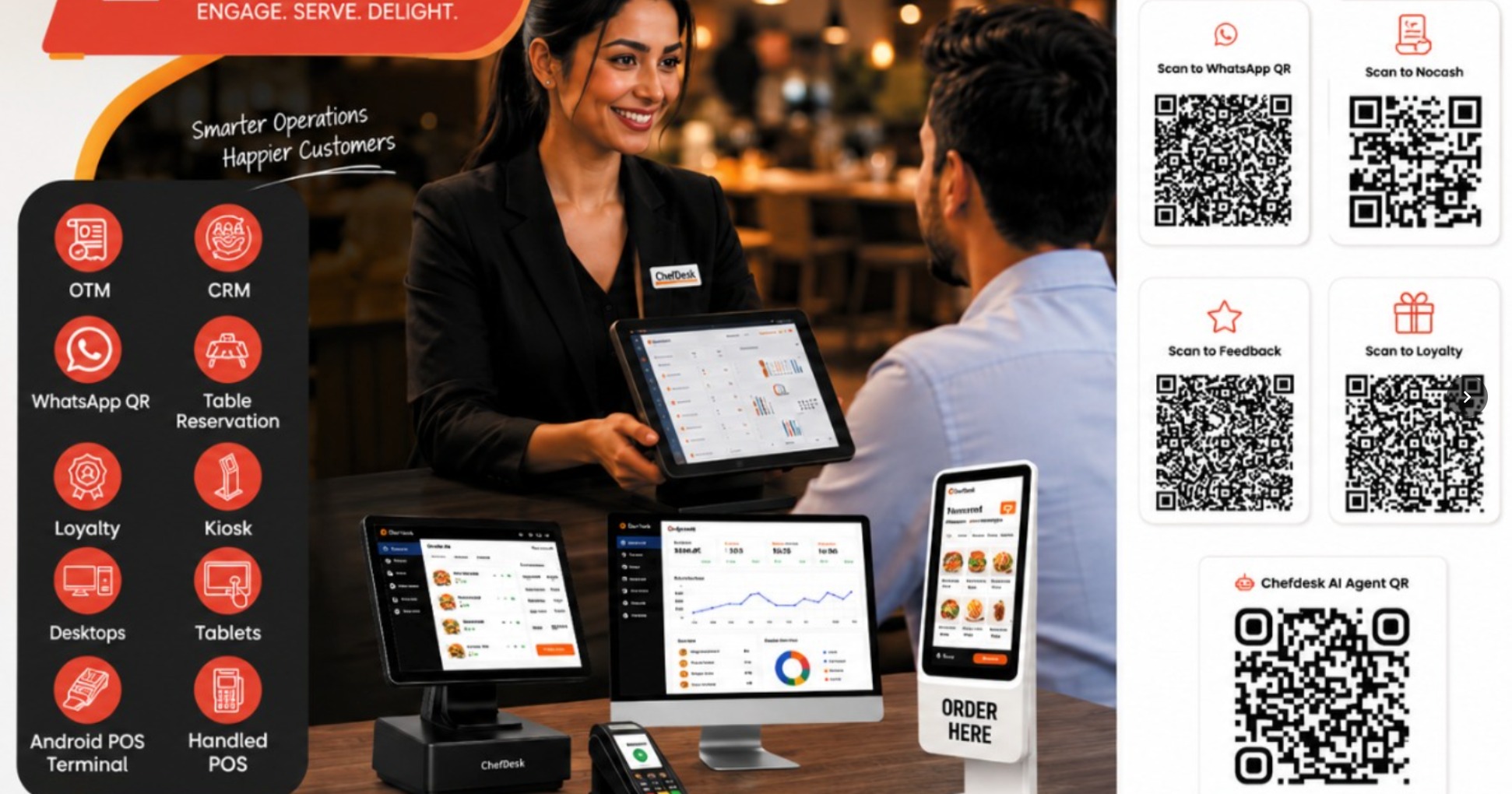
ChefDesk is built for exactly this: one POS behind every channel, so dine-in covers, aggregator orders and WhatsApp orders all arrive in the same place and are treated the same way.
- Order → KOT/KDS, automatically. A WhatsApp order lands as a ticket in the kitchen the same way a captain's order does. No retyping, no second screen, no lost slips.
- Recipe-linked inventory that actually reflects reality. Every dish sold on WhatsApp deducts its ingredients, so your consumption, variance and food cost reports stay honest across channels.
- GST-compliant invoicing on every order. Correct slabs, HSN codes and e-invoicing where applicable — whether the order came from a table, from Swiggy, or from a chat.
- Aggregator sync alongside it. ChefDesk reconciles Zomato and Swiggy payouts commission-accurately, so you can see, outlet by outlet, what each channel actually nets you.
- WhatsApp CRM built in. Loyalty, feedback and reservation flows run on the same customer profile the order created — automatically, based on behaviour, not a generic broadcast.
- Offline-first. ChefDesk runs locally and syncs to the cloud, so a dropped connection at 8:40 PM on a Saturday doesn't take your billing down with it.
More than 5,000 outlets across India run their billing, KOT, inventory and reporting on ChefDesk. The WhatsApp channel isn't a bolt-on to that — it's another door into the same, single source of truth. See the WhatsApp ordering feature page for the product detail.
A 30-day playbook to launch it properly
Week 1 — Set the foundation
Get a dedicated WhatsApp Business number (never a personal one). Load your live menu with correct prices, GST treatment and item-level photos. Connect a UPI collection link. Define your delivery radius and the hours the channel is open.
Week 2 — Wire it to the POS
Route incoming orders straight to KOT. Train exactly two things with your team: how a WhatsApp ticket looks in the kitchen, and who owns the thread when a customer asks a question. Run 20 test orders internally before you tell a single customer.
Week 3 — Acquire, without paying for it
Put a QR on the table tent, the bill folder, the takeaway packaging, the delivery bag insert. Add the number to your Google Business Profile and your Instagram bio. Ask at the counter: "Shall I send the bill on WhatsApp?" — that one question is your cheapest opt-in mechanism, and it collects consent cleanly.
Week 4 — Give people a reason to come back to the thread
Don't try to out-discount an aggregator; you will lose. Compete on things they can't do: a dish that's only available on direct orders, priority slots on busy evenings, free customisation, a loyalty balance that visibly grows, a real human replying in under two minutes.
Ongoing — Win back the lapsed
The highest-ROI campaign in Indian restaurant marketing is the 21-day dormant nudge: a customer who used to order weekly hasn't in three weeks, and gets a personal message referencing their usual order. Set it once; let it run.
Two compliance notes worth getting right
Business-initiated messages must use approved templates, and marketing sends require opt-in. Broadcasting to a scraped list of numbers will get your number rate-limited or blocked — the fastest way to destroy the channel you just built.
Customer names, phone numbers and delivery addresses are personal data. Collect them with clear consent, state what you'll use them for, and honour opt-outs. Capturing consent at billing, inside the POS, keeps this clean and auditable.
The metrics that tell you it's working
Track these monthly, per outlet:
- Direct channel share — WhatsApp orders as a % of total delivery orders. A realistic target in year one is 15–25%.
- Net realisation per order, by channel. The number that justifies the whole exercise.
- Repeat rate at 30 days. Direct customers should repeat meaningfully more often than aggregator customers. If they don't, your follow-up flows are broken.
- Average order value. Chat allows upselling that an app's checkout flow doesn't — track whether your team is actually doing it.
- Opt-in rate at billing. The leading indicator for everything above.
The point
The commission fight will keep making headlines, and every operator should watch how the CCI case and the zero-commission entrants play out. But no restaurant has ever improved its margin by waiting for a platform to become kinder.
The leverage you control is the customer relationship. WhatsApp is where that relationship already lives. All it needs is a system behind it that turns a chat message into a kitchen ticket, an invoice, an inventory deduction and a reason to return — without anyone at the counter typing it twice.