Cloud Kitchen Management Software Built for Multi-Brand Operators
Run 3, 5, or 15 brands from one kitchen. ChefDesk unifies Zomato and Swiggy orders per brand, routes them to the right station, tracks recipe-level food cost, and reconciles every aggregator payout — so you can see what each brand actually earns after commission, discounts, packaging and ad spend.
Multiple brands, one kitchen, one dashboard
Zomato + Swiggy orders per brand, auto-routed
KDS with prep-time & rider-arrival visibility
Per-brand P&L with commission reconciliation
Contribution margin per order, not just gross sales
What the platform does, module by module
1
Multi-brand menus from one admin
Each virtual brand carries its own menu, pricing, descriptions and photos, managed from a single dashboard. Items can be shared where the dish is the same — the biryani sold under three brand names at three price points is one recipe drawing from one stock pool, not three items to maintain. Launch a brand by cloning a menu; kill one by switching it off.
2
Aggregator ingest, per brand
Zomato and Swiggy orders flow directly into the POS tagged by brand and route to the right station instantly — no tablet farm, no manual re-entry. Menu, pricing and availability sync outward too, so marking an item out of stock prevents the cancellation and the rating hit that follows.
3
Kitchen display built for multi-brand
One screen shows every in-flight order with a brand tag, prep timer and bag number. Rider arrival visibility is the piece that matters most: food finished early sits and degrades, food finished late leaves a rider waiting. The consolidated item view lets a cook batch the same dish across brands and tickets.
4
Recipe costing on a shared stock pool
Every brand's items deplete the same raw material inventory, so food cost is real rather than notional. When chicken prices move you see the effect on every brand that uses it. Packaging — containers, bags, cutlery, labels — belongs in the recipe too, or every margin number is optimistic.
5
Per-brand P&L with honest cost allocation
Sales, commissions, discounts, ad spend, packaging and food cost reconciled per brand, daily. Shared costs — rent, labour, utilities, equipment — are allocated on a basis you choose: order volume, revenue share, or prep-time weighting. Pick one, apply it consistently, compare brands on the same footing.
6
Rider handoff and packing accuracy
Bag numbering and order-ready alerts reduce mis-handoffs. The wrong bag to the wrong rider is easy in a multi-brand kitchen and expensive every time — a refund, a rating hit and a remake.
7
Payout reconciliation
Orders received against payouts landed, with commission, cancellations, refunds, promotional deductions and platform adjustments broken out, and discrepancies flagged rather than absorbed. Operators who check tend to find money they were owed.
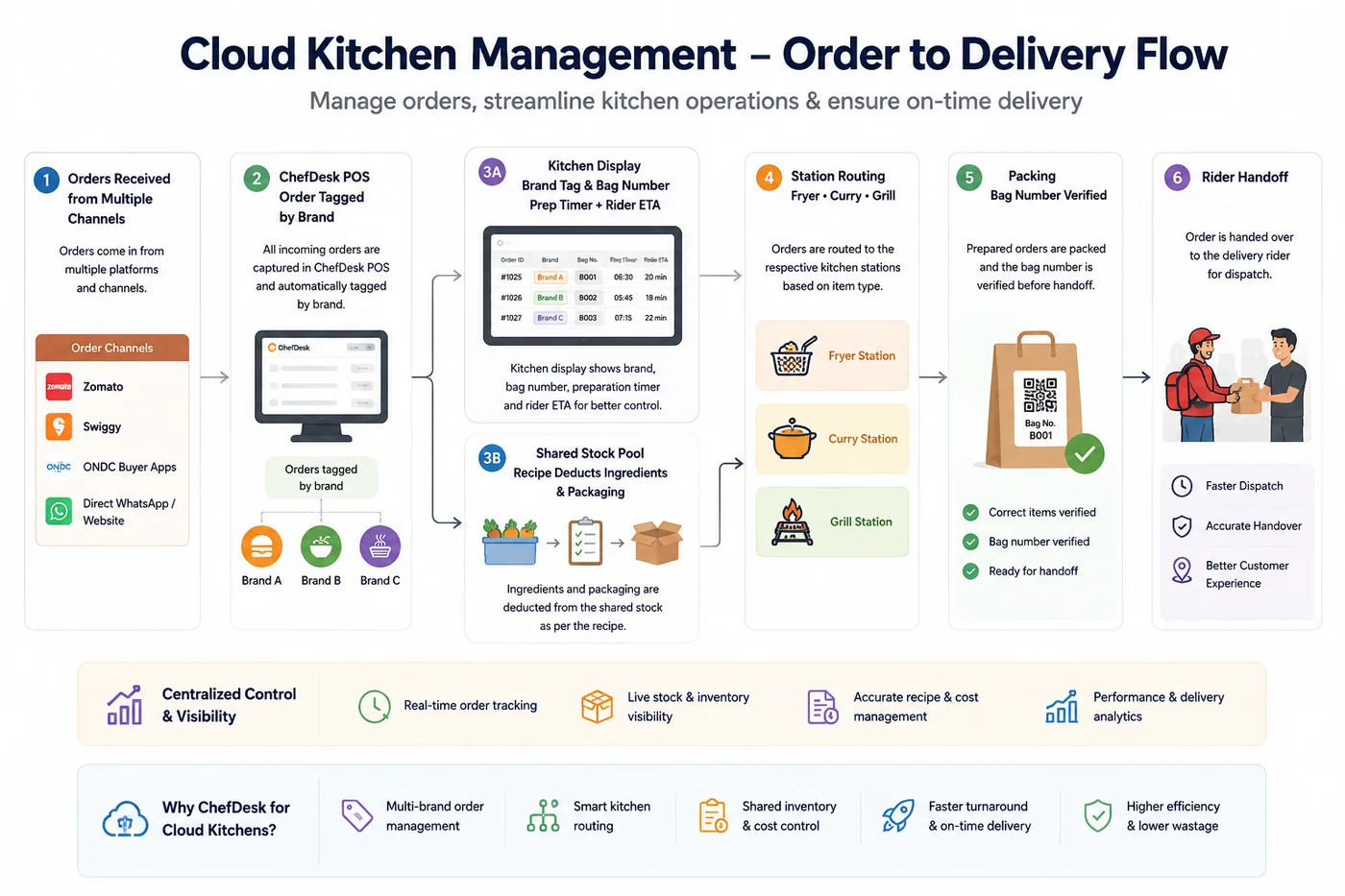
Cloud kitchen order to delivery flow
ChefDesk turns a multi-brand cloud kitchen into a single coordinated system. Orders arrive from Zomato, Swiggy, ONDC buyer apps, direct WhatsApp and your own website, are tagged by brand inside the POS, and routed to the right fryer, curry or grill station. The kitchen display shows brand tag, bag number, prep timer and rider ETA so food is ready exactly when the rider arrives. Stock is deducted from a shared pool as recipes are fired, and every packed bag is verified before handoff — cutting mis-routes, reducing refunds and protecting ratings.
Cloud kitchen order-to-delivery flow: multi-channel orders, brand-tagged POS, shared stock pool, station routing, packing verification and rider handoff.
Why cloud kitchen economics are different
A dine-in restaurant has one brand, one P&L, and a customer who pays the menu price. Almost none of that holds in a cloud kitchen.
You share everything except the P&L. One kitchen, one stock pool, one staff roster, one rent, one electricity bill — supporting five brands that each need to be evaluated separately. The moment you ask "is Brand C worth keeping?", you're asking an allocation question a normal POS cannot answer, because Brand C has no kitchen, cook or rent of its own to point at.
The menu price isn't what you receive. An order listed at ₹450 arrives net of commission, minus the discount the promotion carried, minus the ad spend that won the impression, minus packaging — and it differs by platform, by promotion, and by whether the coupon was yours to fund.
Brands compete for the same equipment — at 8:30 PM every brand peaks and queues for the same stations
Brands are disposable by design; if launching one is a two-week project, you can't test cheaply
There's no walk-in to fall back on — one channel, and the aggregator sets the terms
Capacity planning is a cross-brand problem, not a per-brand one
The number that decides everything: contribution margin per order
Most cloud kitchen operators know their gross sales per brand. Far fewer know their contribution margin per order — and that's the number that determines whether a brand is worth running.
The honest calculation for a single order: listed price, minus discount (including promotions you fund), minus commission, minus payment gateway charges, minus recipe-level food cost, minus packaging, minus allocated ad spend. What's left is contribution toward rent, labour and profit.
ChefDesk computes this per order, per item, per brand and per platform — because it holds the recipe, the packaging cost, the actual aggregator settlement and the ad spend in one place. Assembling it from a POS, two aggregator dashboards and a spreadsheet is possible in theory and doesn't happen in practice. See the food cost calculator and aggregator reconciliation for the underlying mechanics.
A best-selling item that loses money on every discounted order
One brand carrying the kitchen while another consumes capacity at break-even
A platform that looks better on revenue and worse after commission and ads
Promotions that grew order count and shrank total contribution
Reducing aggregator dependence
Commission is the largest single cost line in most cloud kitchens, and it's set by someone else. Operators serious about margin work on channel mix rather than accepting it.
Your own ordering channels — WhatsApp ordering, a website, a link printed on the packaging — keep the commission, and the saving lands entirely on the bottom line. ONDC lets you sell through multiple buyer apps on an open network rather than one aggregator's terms, with orders routing into the same system as everything else. Repeat customers are harder in delivery, where loyalty tends to sit with the platform, but a customer record, a bag insert and a CRM campaign move some of them.
The measurement that matters is channel mix by contribution, not by revenue. A platform delivering 60% of orders and 30% of contribution is a very different proposition from what the gross numbers suggest.
Launching and killing a virtual brand
The cloud kitchen model depends on cheap experimentation, which means brand setup has to be a configuration task rather than a project.
To launch: clone a menu, adjust items and prices, add brand assets, connect the platforms, set the station routing. Live in days.
To evaluate: contribution per order, capacity consumed at peak, repeat rate, rating trend. Judge on contribution rather than revenue — a brand can grow order count while shrinking total profit, and frequently does.
To kill: switch it off. Shared recipes and stock are untouched, historical data is retained for comparison, and no other brand is disrupted. The operators who do well run three or four stable brands plus one or two experiments, and can tell quickly which is which.
Who this is for
Multi-brand cloud kitchen operators running three to fifteen brands from one facility, needing per-brand P&L on shared resources. Single-brand delivery kitchens — everything above applies at smaller scale, with multi-brand capability waiting when you add a second. Restaurant brands running a delivery-only satellite to extend reach without a second dining room. Aggregator-first startups testing brands quickly, where speed to launch and honest kill criteria matter most. Kitchen-as-a-service operators hosting independent brands in one facility, where each tenant needs separated data — see food court billing software for vendor settlement mechanics. And cloud kitchen networks across cities, where multi-outlet restaurant billing adds per-location reporting on top of per-brand.
Compared to the alternatives
Aggregator tablets alone give you orders and nothing else — no shared stock pool, no per-brand food cost, no contribution margin, no payout verification. A standard restaurant POS was built for a dining room: one brand, one menu, one P&L, and no concept of allocating one rent across five brands. Spreadsheets bolted onto a POS can theoretically produce the numbers, but they depend on someone reconciling two aggregator dashboards by hand every week, which is why it stops happening by month two.
ChefDesk does all of it in one place: per-brand order ingest, per-brand menus and pricing on a shared stock pool, recipe-level food cost with packaging, contribution margin per order, shared cost allocation, payout reconciliation, brand tags and bag numbers on the KDS, and a new brand live in days.
Frequently Asked Questions
What is cloud kitchen management software?+
It's a single platform that runs a delivery-only kitchen — ingesting orders from Zomato, Swiggy, and your own app, routing them to prep stations, tracking recipe-level food cost, and reconciling aggregator payouts per brand.
Can I run multiple brands from one kitchen with ChefDesk?+
Yes — that's a core use case. Each virtual brand has its own menu, pricing, and P&L while sharing the same physical kitchen and stock pool.
Does it integrate with Zomato and Swiggy?+
Yes. Orders ingest directly into the POS per brand, and payouts reconcile against orders with commission-level accuracy.
How does the KDS handle multi-brand orders?+
Every ticket on the KDS carries a brand tag and a bag number, so cooks and packers never mix up orders across brands.
Can I track food cost per brand?+
Yes. Because every brand's recipes point to the same raw-material pool, ChefDesk computes real per-brand food cost daily.
Is ChefDesk suitable for a small single-brand cloud kitchen?+
Yes — start with one brand on the standard plan. Multi-brand features unlock the moment you add a second brand, at no re-implementation.
How do I know whether a brand is actually profitable?+
By contribution per order rather than gross sales — listed price minus discount, commission, payment charges, recipe-level food cost, packaging and allocated ad spend. ChefDesk computes it per order, per item, per brand and per platform, because it holds the recipe, the packaging cost, the actual settlement and the ad spend in one place. Brands that look strong on revenue frequently look different on contribution.
How are shared costs like rent and labour split between brands?+
You choose the allocation basis — order volume, revenue share, or prep-time weighting — and it's applied consistently. The basis genuinely changes the answer: allocating rent by revenue flatters premium low-volume brands, while allocating by order count flatters high-ticket ones. What matters is that every brand is judged on the same footing.
Can several brands share the same dish?+
Yes. The same biryani sold under three brand names at three price points is one recipe drawing from one stock pool, with separate pricing and reporting per brand. You maintain the recipe once.
Does packaging cost get included in food cost?+
It should, and ChefDesk supports it. Containers, bags, cutlery and labels are a real per-order cost in delivery-only operations and are commonly left out — which makes every margin figure look better than it is.
Can ChefDesk tell me when to start cooking relative to rider arrival?+
The KDS shows prep timers alongside rider ETA where the aggregator exposes it. Food finished too early sits and degrades; finished late means a waiting rider and a delayed delivery. Timing prep against arrival avoids both.
How quickly can I launch a new virtual brand?+
Clone an existing menu, adjust items and prices, add brand assets, connect the platforms and set station routing — days rather than weeks. Killing a brand is switching it off, with shared recipes and stock untouched and historical data retained.
Can I reduce my dependence on Swiggy and Zomato?+
Partly, and it's worth working at, since commission is usually the largest cost line and it's set by someone else. Direct channels — WhatsApp ordering, your own website, an insert in the packaging — keep the commission, and the saving lands entirely on the bottom line. ONDC provides an additional route through multiple buyer apps. Track channel mix by contribution rather than revenue.
Can I check whether aggregator payouts are correct?+
Yes. Orders received are reconciled against payouts landed, with commission, cancellations, refunds, promotional deductions and platform adjustments broken out, and discrepancies flagged. Most operators accept settlements as they arrive because manual checking isn't practical; those who check tend to find discrepancies.
Do I need a different setup for a cloud kitchen than a restaurant?+
Usually simpler — no counter, no captains, often a single billing device plus KDS screens. The smartphone or tablet POS setup fits most single-facility cloud kitchens; compare options on the technology page.