How does food court billing software handle vendor settlement?+
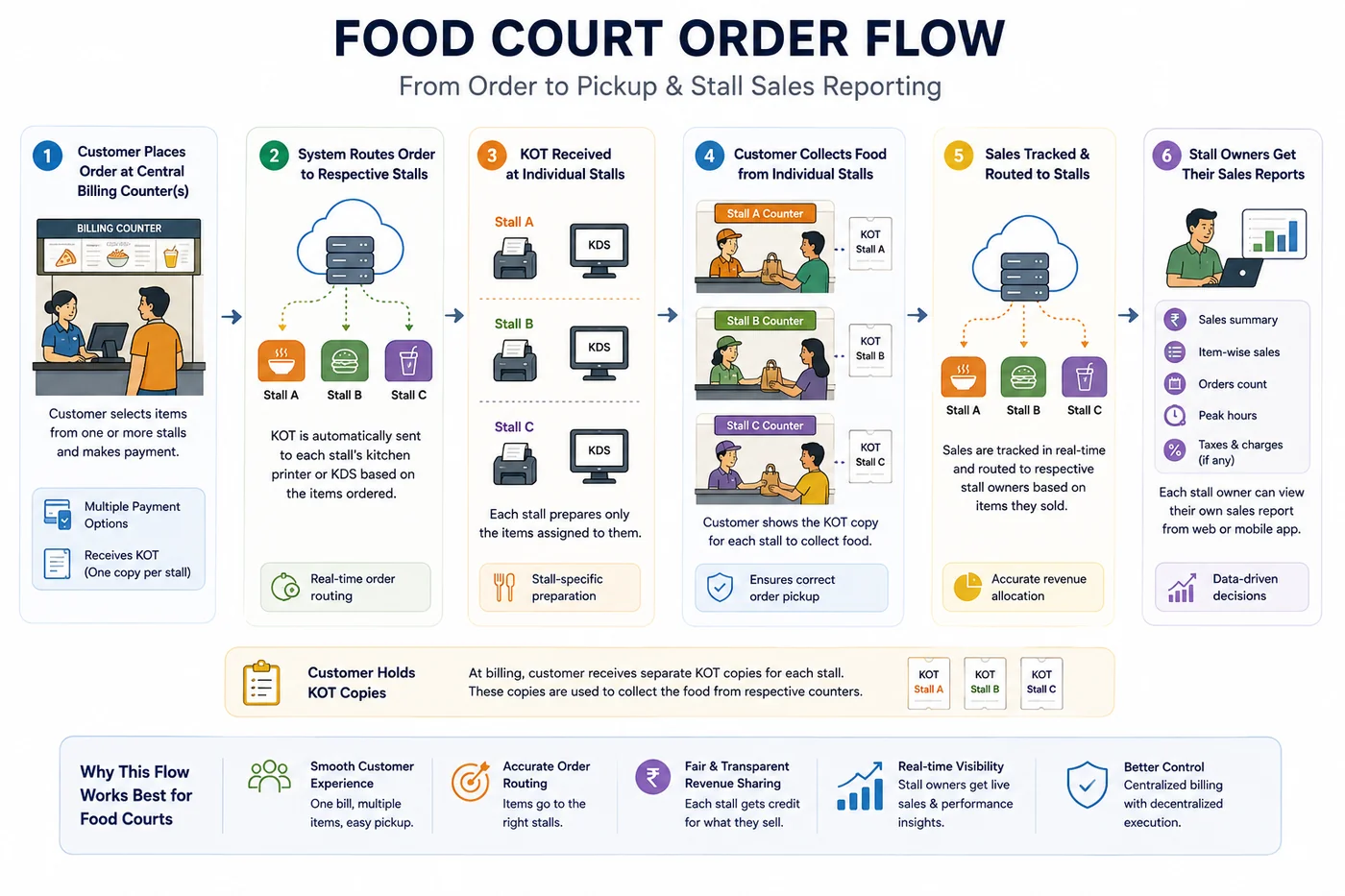
Every item sold is attributed to the stall that produced it, regardless of where it was billed. At the end of your settlement cycle the system totals each vendor's gross sales, applies their agreed commission or revenue-share terms, and generates a payout statement. Both operator and vendor see the same underlying transactions, which is what prevents disputes.
Can a customer pay once for items from different stalls?+
Yes. A single order can include items from several vendors, taken at a central counter, kiosk or QR menu. Payment is collected once, the order routes to each relevant kitchen separately, and the revenue splits to the correct vendors automatically.
Does it support prepaid or RFID cards?+
Yes. Customers top up a card at a kiosk or counter and tap at any stall. You can configure validity, minimum balance, security deposit, PIN requirements and refund rules for unused balance. Card transactions work offline, which matters in basement and mall locations.
Do individual vendors get their own reports?+
Yes. Each vendor can have a login showing only their own sales, item performance and settlement statements. Operators generally find that giving vendors this visibility ends most reconciliation arguments before they start.
How is GST handled when several vendors bill under one system?+
Each vendor holds its own GSTIN, tax rates and HSN codes, and invoices are generated on that basis. Whether the invoice is raised by the vendor or by the operator has genuine GST implications and depends on how your tenancy and billing arrangement is structured — decide that with your CA, and we'll configure the system to match either way.
Will it work if the internet goes down during lunch rush?+
Yes. Billing and card transactions run locally and continue through an outage, syncing to the cloud once connectivity returns. Given how many food courts sit in basements behind restrictive mall networks, this is a core requirement rather than an edge case.
Can each stall keep its own menu and prices?+
Yes. Vendors control their own items, prices and promotions independently. The operator can separately run court-wide campaigns across all stalls.
How does the kitchen know what to make?+
Orders route automatically to the correct stall's kitchen display or printer. Each kitchen sees only its own items and marks them ready, which updates the customer-facing token display.
Is it suitable for a corporate cafeteria rather than a mall?+
Yes. Corporate cafeterias typically use employee wallets or card entitlements, subsidised pricing, and monthly reconciliation with admin or HR. All of that is supported, including spend caps and department-wise reporting.
How many stalls can it handle?+
There's no practical limit for a single food court. Multi-location operators can also run several courts under one account with consolidated and per-location reporting.
How long does implementation take?+
Two to five days for most food courts, depending on the number of vendors. The time goes into menu configuration and settlement terms rather than installation.
What happens to unused prepaid card balance?+
Refund rules are configurable — refund at exit, carry forward, expire after a set period, or retain a security deposit. Set the policy to match what you've committed to your customers.